In October 2026, the headlines said Anthropic had passed OpenAI in revenue. Reuters, citing unnamed sources, reported that Anthropic’s annualized revenue crossed $65 billion in July. OpenAI reportedly told investors its annualized revenue for September was almost $50 billion, below the figure approaching $70 billion it had signaled earlier. Keep in mind these are press reports, not reported financial results.
Did Anthropic really pull ahead? Partly. But a good chunk of the gap comes from how each company counts revenue sold through the big cloud marketplaces.
On October 26, Anthropic filed its highly awaited S-1. Now we have Anthropic’s actual reported revenue through June 30, 2026, and we don’t have to guess how it counts that revenue. Here is what the filing says and why it matters for anyone benchmarking SaaS or AI revenue.
Principal vs. Agent in Plain English
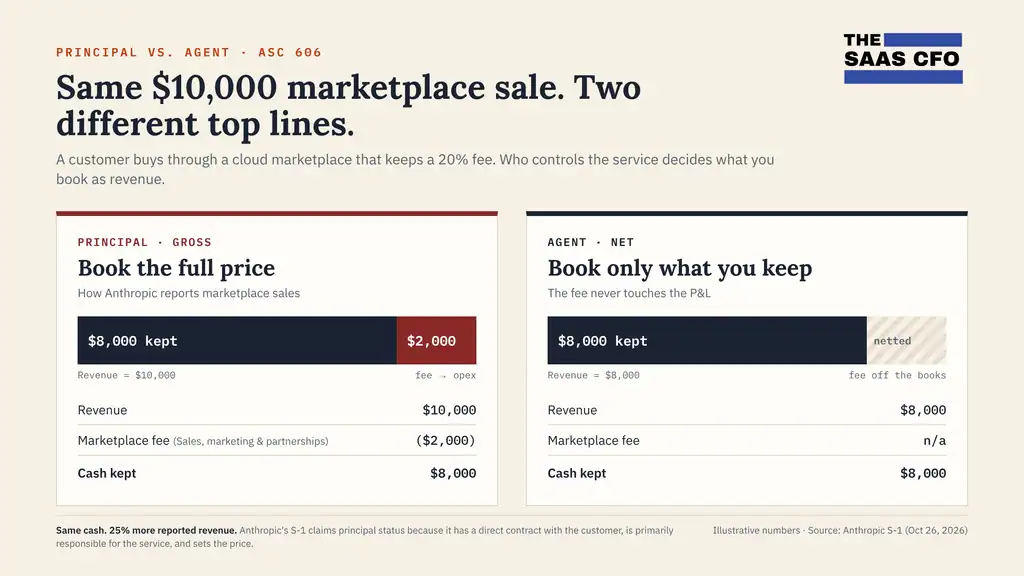
When you sell through a marketplace like AWS, Google Cloud, or Azure, ASC 606 makes you answer one question. Who controls the service before the customer gets it?
- If you do, you are the principal. You book the full price as revenue (gross).
- If the marketplace does, you are the agent. You book only what you keep (net).
This is not a policy election. The facts of your contracts decide it. The bullets above are high level guidance. Make sure your auditor agrees.
What Anthropic’s S-1 Says
Anthropic says it is the principal. From the revenue recognition note:
“In these arrangements, the Company is the principal and recognizes revenue on a gross basis because the Company has a direct contractual relationship with customers, is primarily responsible for providing the intelligence service to customers, and establishes pricing. The CSPs in these arrangements do not obtain control of the Company’s intelligence service at any point prior to transfer to the customer.”
The S-1 describes the cloud providers as collection agents. They bill the customer, collect the cash, and remit it to Anthropic “net of applicable platform and other fees.”
This applies to all three clouds. Claude is sold through Amazon Bedrock, Google Cloud, and Microsoft Foundry on Azure. And it is a big channel. Cloud marketplace sales were 47% of revenue in 2025 and 48% in the first half of 2026.
Where the Marketplace Fee Goes
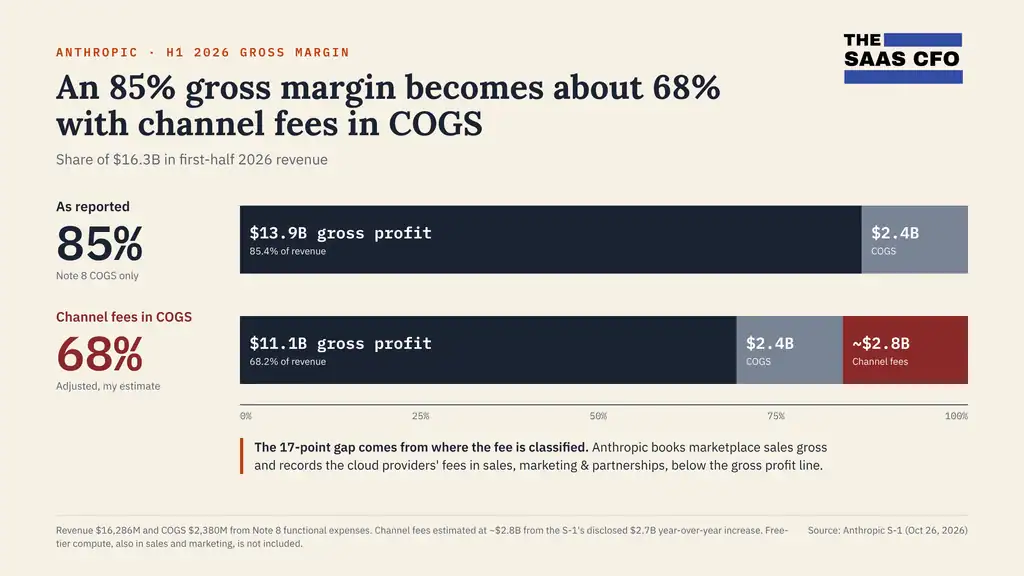
If revenue is booked gross, the cloud provider’s cut must land somewhere on the software P&L. For Anthropic, it lands in operating expenses, in a line called “Sales, marketing, and partnerships.” The S-1 says that line consists primarily of fees paid to channel partners.
You can see it in the numbers. That line went from 10% of revenue in the first half of 2025 to 19% in the first half of 2026. Anthropic says $2.7 billion of the increase came from higher channel partner fees.
The S-1 doesn’t disclose a rate. Reuters put it at about 16% of each dollar sold through the partners.
Where OpenAI Fits
Per Reuters, OpenAI’s figures do not include the full value of sales through cloud partners. Anthropic’s does. The source also said OpenAI’s earlier, higher number came from an attempt to produce a direct comparison with Anthropic.
So the two headline numbers were not measured the same way.
A Simple Example
Say a customer spends $10,000 on API calls through a cloud marketplace. The cloud keeps a 20% fee. Compute to serve that usage costs $4,000. These are illustrative numbers.
| Gross reporter | Net reporter | |
| Revenue | $10,000 | $8,000 |
| COGS (compute) | $4,000 | $4,000 |
| Gross profit | $6,000 | $4,000 |
| Gross margin | 60% | 50% |
| Where the $2,000 fee goes | Operating expenses | Netted out of revenue |
| Cash kept after fee and compute | $4,000 | $4,000 |
Same customer. Same cash. One company looks 25% bigger with a 10-point higher gross margin.
Now scale it. Put a 20x revenue multiple on $100 million of marketplace sales. Gross, that’s $2.0 billion of value. Net, it’s $1.6 billion. That’s $400 million of value from a revenue presentation difference.
Does It Explain the Whole Gap?
Not based on the figures in the news. The S-1 doesn’t disclose rate, but it says channel partner fees rose $2.7 billion year over year. By my estimate, that puts them at about 17% of Anthropic’s total revenue (not of marketplace sales) in the first half of 2026. Take 17% off the reported $65 billion and you get about $54 billion. That’s still above OpenAI’s reported $50 billion. Remember, both are press figures, not filed results.
Gross vs. net explains a large part of the gap. Not all of it.
Here is what the S-1 actually reports. Revenue was $16.3 billion in the first half of 2026, including $11.6 billion in Q2. Q3 revenue and the October run rate are left blank in this first filing. The filing does say Q3 revenue was 86 times Q4 2024 revenue of $197 million, which implies about $17 billion. Expect the actual figures in a later amendment.
The Gross Margin Detail Most People Will Miss
Anthropic doesn’t show a real gross profit on its income statement which is too bad. It’s a bit of a guessing game. It presents expenses by type, like compute and personnel. But a footnote breaks expenses out by function, including COGS.
Using that footnote, first-half 2026 COGS was $2.4 billion on $16.3 billion of revenue. That’s about an 85% gross margin.
The channel fees sit in sales and marketing, below the gross profit line. Move about $2.8 billion of channel fees into COGS and gross margin drops to about 68%.
That’s the bigger distortion. Restating Anthropic to net moves its gross margin about 3 points, because only about half of revenue runs through the clouds. Where the partner fee is classified moves gross margin about 17 points.
Run-Rate Revenue Is Not ARR
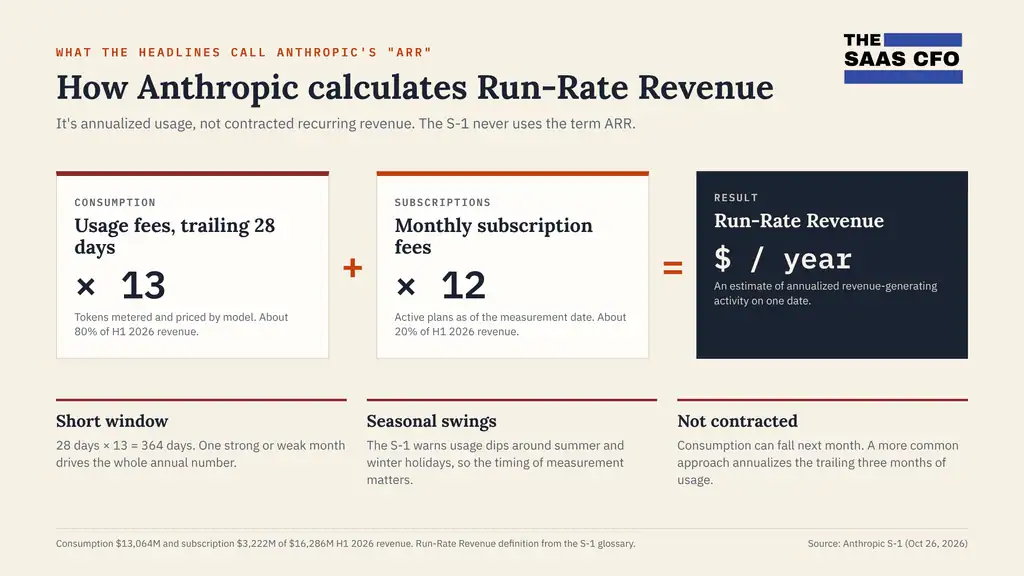
One more thing. The S-1 never uses the term ARR. Anthropic reports “Run-Rate Revenue,” calculated as:
- Consumption fees from the trailing 28 days, times 13
- Plus monthly subscription fees, times 12
The S-1 leaves the actual Run-Rate Revenue figure blank for now. Most of Anthropic’s revenue is consumption based. So this is annualized usage, not contracted recurring revenue. The S-1 warns it can swing with seasonal slowdowns around summer and holidays. It also estimates that 5% to 7% of revenue in the first nine months of 2026 came from customers violating its usage policies.
It’s a useful metric. It’s just not ARR in the SaaS sense. But I don’t want to hear that ARR or SaaS metrics are broken. Defining ARR is alive and well in my SaaS CFO community.
Anthropic uses a shorter consumption annualization window than most public tech companies per my research. It’s most common to annualize the trailing three months of usage revenue to create a usage ARR number.
Takeaways for SaaS and AI Operators
- Know if you are principal or agent. Your marketplace contracts decide it, not your preference. Settle it before your auditors call you out. This does not just apply to marketplace agreements. It also applies to reseller agreements.
- Normalize before you compare. When benchmarking against peers, put everyone on the same basis. Net of marketplace fees is the cleanest.
- Check where the fee sits. If you report gross, the marketplace fee is a real cost of the channel. Make sure your board sees it in your CAC and channel economics.
- Read the metric definition. ARR, run-rate, and annualized revenue can mean very different things. The definition is always in the filing. Be transparent on how you disclose ARR to your Board, investors, and potential investors.
Sources
- Anthropic, PBC, Form S-1 (October 26, 2026): https://www.sec.gov/Archives/edgar/data/2130357/000162828026067168/anthropicpbc-sx1.htm
- Reuters, “OpenAI’s annualized revenue $20 billion less than previously signaled, FT reports” (October 8, 2026): https://www.ksl.com/article/51634189/openais-annualized-revenue-20-billion-less-than-previously-signaled-ft-reports
- FASB ASC 606-10-55-36 to 55-40, Principal versus agent considerations

I have worked in finance and accounting for 25+ years. I’ve been a SaaS CFO for 9+ years and began my career in the FP&A function. I hold an active Tennessee CPA license and earned my undergraduate degree from the University of Colorado at Boulder and MBA from the University of Iowa. I offer coaching, fractional CFO services, and SaaS finance courses.