If you are infusing AI into your SaaS product, there is one finance mistake you cannot make:
Treat AI costs like traditional SaaS COGS.
The P&L math did not change. But the inputs changed.
That matters because the classic SaaS model was built on high gross margins and low marginal cost. Add AI inference costs, model-routing costs, vector database costs, and other AI infrastructure, and that margin profile can change fast.
Traditional SaaS businesses have typically targeted 70–80% gross margins, while ICONIQ’s 2026 State of AI says surveyed AI product builders expect average gross margins to reach about 52% in 2026.[1][3]
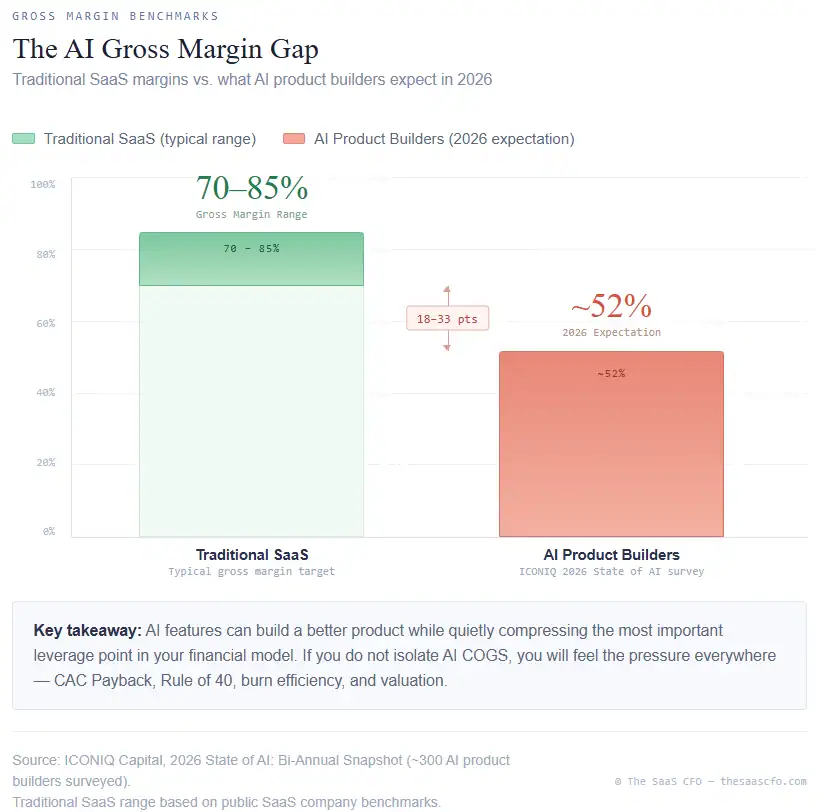
So yes, AI can create a better product.
It can also quietly pressure the most important leverage point in your financial model.
And if you do not isolate that pressure in your SaaS P&L, you are going to feel it everywhere else: CAC Payback, Rule of 40, burn efficiency, and ultimately valuation.

Why AI COGS Matters
I teach gross margin as one of the core pillars in my SaaS Metrics Foundation course for a reason.
Gross margin determines how much room you have to invest in R&D, sales, marketing, and G&A. If you compress gross margin, you compress everything downstream.
Therefore, AI COGS is not just a product discussion. It is a finance and operating model discussion.
The mistake I see is that teams ship AI, watch usage grow, celebrate adoption, and only later realize that their cost to deliver the product has changed structurally.
By that point, they usually did not set up the right framework to track the cost in the first place.
The AI COGS Shift
Traditional SaaS COGS was mostly predictable. Hosting, support, customer success depending on how you classify it, maybe services if you have onboarding, and DevOps. As revenue scaled, you expected efficiency over time. That is what your Board and investors expected too.
AI changed that.
Each prompt, workflow, generation, or agent action triggers real variable cost. Costs that post directly into DevOps in COGS.
AI COGS behaves more like a usage-sensitive cost layer than traditional software delivery.
ICONIQ’s 2026 report also shows that AI monetization models are still evolving, with companies experimenting across subscription, consumption, and outcome-oriented approaches.[1]
In other words, this is not a rounding-error line item.
A Simple Software Margin Example
Let’s keep this simple.
Say you have a SaaS product generating $100 of revenue.
Under a more traditional SaaS model, maybe your direct COGS is $20. That gives you an 80% gross margin.
Now you add AI features, and those features add $15 of direct variable cost between inference, routing, and AI infrastructure.
Your revenue is still $100. But now your COGS is $35.
Your gross margin just went from 80% to 65%.
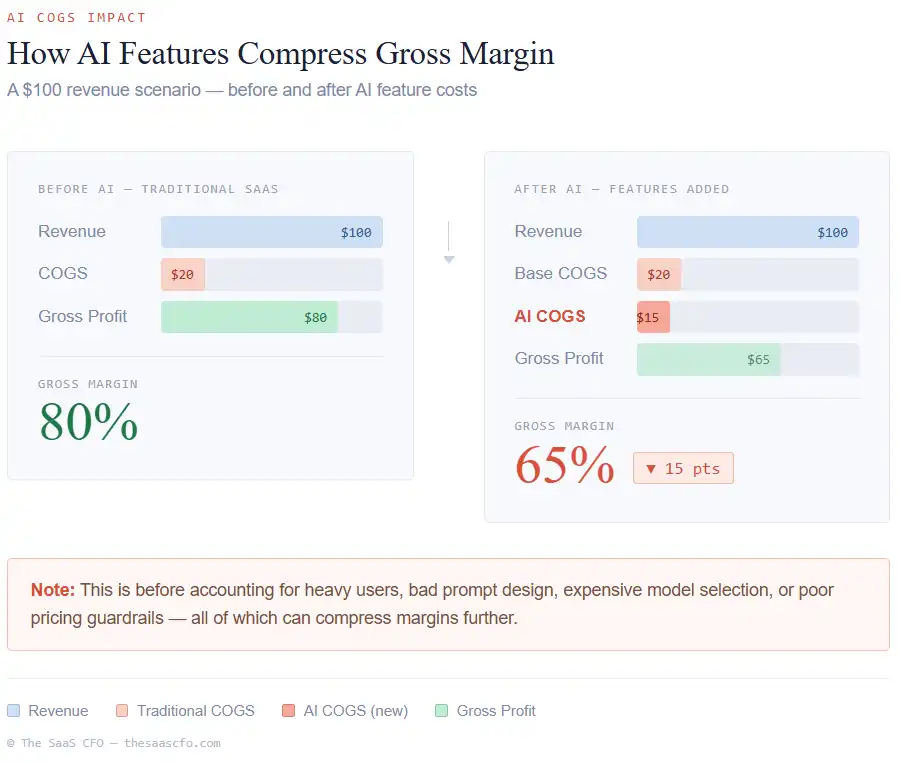
That is before you even talk about heavier users, bad prompt design, expensive model selection, or poor pricing guardrails.
That is the issue.
You can build a more valuable product and still weaken the economics if your pricing and packaging do not keep up.
Where AI COGS Belongs on Your SaaS P&L
This is where a lot of companies get into trouble.
If you bury AI costs in one generic hosting or software bucket, you lose the ability to answer the most important question:
What is the gross margin of the revenue stream or feature set that is driving these costs?
Start with the proper SaaS P&L.
You need clear and distinct revenue streams. For most companies, that means some combination of:
- Subscription revenue
- Variable revenue
- Professional services
- Managed services
- Hardware
- Other
Then your COGS has to match the revenue model.
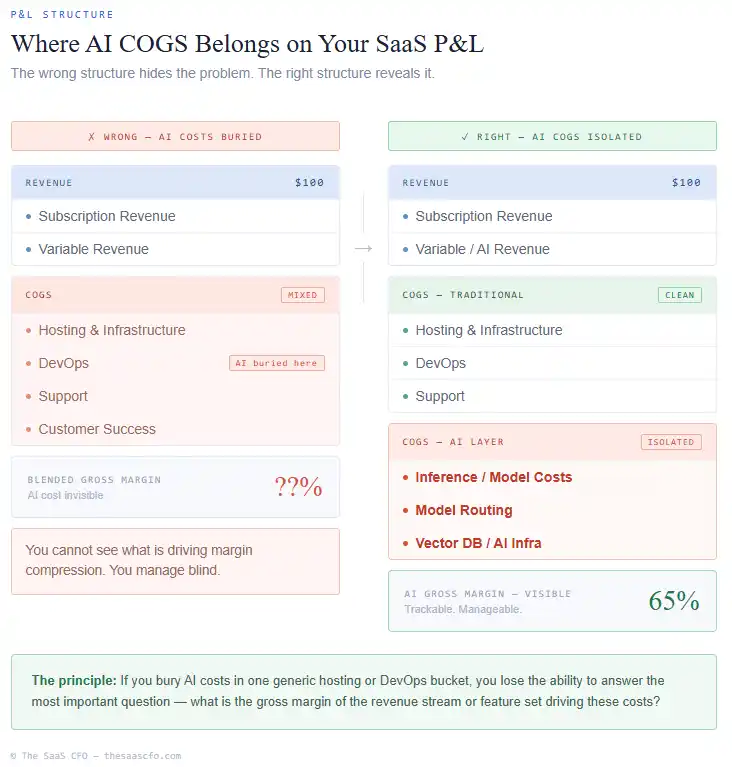
If AI is embedded inside subscription revenue, you still need a way to isolate the direct AI cost layer supporting that revenue. If AI is monetized separately, it is even better. Break it out so you can see AI revenue and AI COGS more directly.
Do not mix subscription and variable economics.
If you do, you will end up with an overall gross margin number that hides the real problem.
Finance should not start with the prompt or the demo. Finance should start with the revenue structure, the COGS structure, and the usage data.
Margins by Revenue Stream Matter Even More Now
This is not just about overall gross margin.
You need margins by revenue stream.
If your legacy subscription business is still running very healthy margins, but your AI-heavy layer is running materially lower margins, that is important to know. Otherwise, you will look at the blended number and not know where to focus.
AI is making “margins by revenue stream” far more important than they already were.
If your overall gross margin starts slipping, you need to know exactly which layer of revenue is driving it.
The Public Market Signal
This is no longer a private-company-only discussion.
In Salesforce’s February 2026 earnings release, the company said Agentforce ARR reached $800 million, up 169% year over year, with more than 29,000 deals closed and nearly 20 trillion tokens processed to date.[2]
That does not prove a specific margin problem itself.
But it does prove the scale of AI usage now flowing through enterprise software. Once AI activity becomes material at that level, you can assume finance teams are watching the economics carefully.
And Salesforce’s own operating data shows this is not just a logo-acquisition story. More than 60% of AgentForce and Data 360 Q4 bookings came from existing customer expansion.[2] AI is providing a rebirth to legacy SaaS players.
If you are a $5M, $10M, or $20M ARR company, you should be doing the same thing now, not later.
Three Things Every SaaS CFO Should Do
1. Isolate AI COGS Now
Do not wait.
Create the visibility now so you can measure:
- AI COGS as a percent of AI-related revenue
- AI COGS as a percent of total revenue
- AI cost per active user
- AI cost per request, workflow, LLM, or token bucket
- Margin by product line or feature family where practical
If you cannot answer what your AI gross margin is, you are managing this blind.
2. Align Pricing with Cost Structure
If cost scales with usage, your pricing must acknowledge that reality.
That does not mean you have to charge purely by token or prompt. But it does mean you need some combination of:
- platform fee plus usage
- tiered usage buckets
- overage pricing
- soft caps
- feature-based packaging
- higher-tier access to heavier AI workflows
That said, a lot of founders are still keeping pricing simple in the early innings. Nicolas Christiaen, founder of Donna, put it this way: “We have a subscription based model based on the number of seats in the team. It’s pretty simple today… we wanna keep it simple.”[5]
Other founders are already landing in a hybrid model. Matthieu Hafemeister, founder of Concourse, described it this way: “Today, most of the customers that we bring on, we have a flat platform fee… and then we layer on tokens and credits on top… we really think about that in terms of the output that the agents are producing.”[6]
That is probably where more of the market ends up: some fixed platform economics, plus some variable layer tied to usage or output.
The big idea: price on value, but protect the long tail.
AI COGS problems usually do not show up in the average user. They show up in the heavy user, the power workflow, and the poorly constrained feature.
And there is another reality here. Buyers are getting smarter about AI cost. As Rafael Broshi, founder of Notch, put it, customers are already asking what happens if AI costs collapse and whether they should share in that benefit.[8]
That matters.
Even if your cost basis improves, you may not keep all of that improvement. Customers will push for their share too.
3. Show the Margin Roadmap
Boards and investors do not need perfection. They need clarity.
If you are running lower margins because AI is a meaningful part of your product, then show the path.
That path usually comes from some combination of:
- better model routing
- smaller models where appropriate
- caching
- prompt optimization
- better packaging
- higher ACVs
- better attach rates on paid AI features
- infrastructure optimization over time
The point is not to tell a fantasy story that you will magically get back to 80% overnight.
The point is to show that you understand the economics and are actively engineering margin improvement into the model.[3]
And importantly, the public company playbook here is not panic. It is optimization. Robin Washington, COFO at Salesforce, put it well: “Short term, we don’t see gross margins getting worse, fairly neutral… tokens… are going to start to go down over time and commoditize… engineering and product is working on ways to… reduce the overall cost.”[4]
That is exactly how a CFO should think about this. AI COGS is real, but it is not static. It needs active management.
I also liked how Nicolas framed it from the founder side: “I think everything will normalize to that 70, 80% over time… there’s still a lot of improvement potential in being more efficient with the tokens. And then the token price will actually also decrease.”[5]
That is the right mindset.
Maybe you are not at traditional SaaS margins today. Fine. Then show the roadmap to better unit economics over time.
What AI Metrics I’d Put on the Monthly Dashboard
If I were building the monthly package for a SaaS company with meaningful AI usage (just helped one AI founder with a major VC raise), I would add these:
- AI COGS as a % of AI-related revenue
- AI COGS as a % of total revenue
- AI gross margin
- Cost per active AI user
- Cost per AI workflow or request
- AI attach rate
- Paid AI feature adoption
- AI revenue mix as a % of total revenue
- Blended gross margin vs. non-AI gross margin
- Top-decile user cost vs. median user cost vs. bottom-decile user cost
That last one matters more than people think.
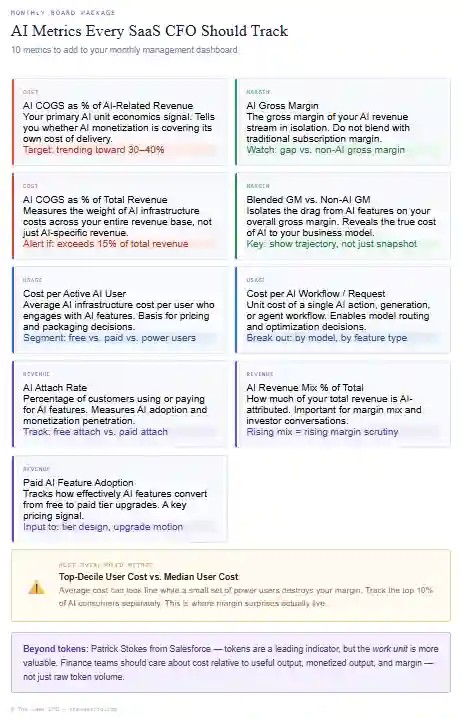
Average cost can look fine while a small set of users destroy your margin.
And I would not stop with tokens alone. Patrick Stokes, President and CMO at Salesforce, made this point clearly: tokens are a leading indicator, but the work unit is a more valuable indicator of where value is actually coming from.[7]
That is an important nuance.
Usage matters. But finance teams should care even more about cost relative to useful output, monetized output, and margin.
Bottom Line
AI can absolutely make your SaaS product better.
It can also change the economics of your SaaS business faster than most teams expect. So if you are building AI into your product, do not just ask whether customers want it.
- Ask where it sits on the P&L.
- Ask how it changes your gross margin.
- Ask whether pricing and packaging still make sense.
- And ask whether your team can see the answer clearly in the numbers.
Because the companies that win with AI will not just be the ones that ship it fastest.
They will be the ones that understand the economics well enough to scale it profitably.
Action Items
Pull your monthly SaaS P&L and answer these five questions:
- Do I have clear and distinct revenue streams?
- Can I isolate AI-related COGS from traditional SaaS COGS?
- Can I calculate margins by revenue stream?
- Is my pricing aligned with AI usage and cost distribution?
- Can I show a credible path to margin improvement over the next 12–24 months?
If the answer is no to any of those, that is where I would start.
Sources
[1] ICONIQ Capital, 2026 State of AI: Bi-Annual Snapshot — based on survey insights from about 300 executives building AI products; supports the 2026 expected gross-margin figure and the broader point that AI monetization models are still evolving.
[2] Salesforce, Salesforce Delivers Record Fourth Quarter Fiscal 2026 Results — supports Agentforce ARR at $800 million, up 169% year over year, more than 29,000 deals, nearly 20 trillion tokens processed, and more than 60% of Q4 bookings coming from existing customer expansion.
[3] Monetizely, Why AI COGS Matters for SaaS Companies — supports the broader framing that traditional SaaS gross margins are typically much higher than AI-heavy products and that boards care about margin trajectory, usage tiers, and a roadmap back toward stronger margins.
[4] Salesforce, Inc. (CRM) Q4 2026 Earnings Call Transcript — Robin Washington on token commoditization, cost reduction, and near-term gross-margin impact.
[5] The SaaS CFO podcast interview with Nicolas Christiaen from Donna — on keeping AI pricing simple early and on AI gross margins normalizing over time through better token efficiency and lower token prices.
[6] The SaaS CFO podcast interview with Matthieu Hafemeister from Concourse — on hybrid AI pricing using a platform fee plus tokens/credits tied to output.
[7] Salesforce, Inc. (CRM) Q4 2026 Earnings Call Transcript — Patrick Stokes on tokens as a leading indicator versus work/output.
[8] The SaaS CFO podcast interview with Rafael Broshi from Notch — on customers asking to share in the benefit if AI costs materially decline.

I have worked in finance and accounting for 25+ years. I’ve been a SaaS CFO for 9+ years and began my career in the FP&A function. I hold an active Tennessee CPA license and earned my undergraduate degree from the University of Colorado at Boulder and MBA from the University of Iowa. I offer coaching, fractional CFO services, and SaaS finance courses.