I have spent years forecasting software and SaaS company financials. One area of the P&L that receives extra scrutiny from leadership and investors is the sales and marketing area.
It’s easy to get lost in a sea of SaaS metrics, but in this post, I’ll focus on a couple easy and popular (meaning important) SaaS sales efficiency metrics that will help you gauge the efficiency of your sales and marketing process.
Sales Metric #1 – Cost of Net New ARR
Let’s dive right into a metric that gets to the heart of sales efficiency. That is the cost of net new ARR (annual recurring revenue).
First, what is net new ARR? Net new ARR equals ARR from new business acquisition and the incremental ARR from expansion and upsell. Please do not include any normal renewals in this number. It’s just the net ARR coming into your business.
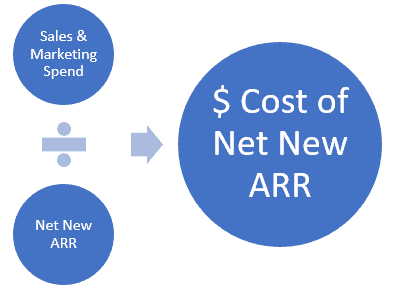
Cost of Net New ARR Formula
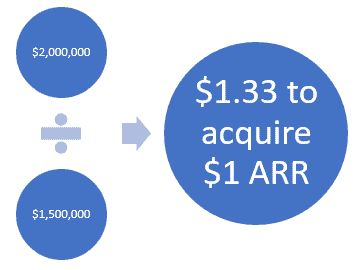
You simply divide your total sales and marketing spend by your net new ARR bookings. What results is the cost to acquire one net new dollar of ARR. You can measure this by month, quarter, YTD, or year. Just select a long enough time period to minimize any month-to-month volatility that might skew the result.
Why The Cost of ARR is a Great Metric
This metric is great for two reasons. It doesn’t require a mature accounting process or a bunch of reports. You just need your total sales and marketing spend and bookings. Secondly, it’s simple and informs you immediately about your acquisition efficiency. Not much room for debate.
Net new ARR is the life source for any SaaS business, so you should be tracking this number. And even if you have a basic QuickBooks P&L by expense category, you should be able to isolate your sales and marketing spend. Though, wages might be tricky if they are in one bucket.
Your sales and marketing spend should be fully burdened. This includes sales and marketing wages, taxes, benefits, commissions, advertising, trade shows, conferences, swag, travel, etc. You might need the help of your bookkeeper or accountant to cull out the related general ledger transactions if your expenses are categorized generically.
This post sponsored by TrueRev.com
Trouble Finding your Sales and Marketing Spend?
If finding your exact sales and marketing spend is difficult, please check out my posts on how to structure your SaaS chart of accounts. If you are at several million dollars of ARR, I recommend coding your expenses to the department level. It makes this calculation a breeze and repeatable.
SaaS Benchmarks
What’s also great about this sales efficiency metric (actually, a third reason) is that you can then compare your number to KeyBanc’s SaaS Private SaaS Company survey.
To spoil the surprise, the cost to acquire $1 dollar of new logo ARR is $1.15 (median). The cost to acquire $1 of new expansion revenue is $0.57 (median). I highly recommend that you download this survey as there is some great comparative data on SaaS metrics and other important financial measures.
Sales Metric #2 – CAC Payback Period
Now that we have our cost of net new ARR, it’s easy to add one more step to this formula to derive your overall CAC Payback Period in months. To be technically correct, we are going to be calculating your net ARR payback period.
You just need to know your recurring revenue margin. To learn more about margins, check out my post on how to calculate your SaaS gross margin and recurring revenue margin.
Net ARR Payback Period Formula
This is a little different take on CAC Payback. Typically, you think of payback for just new customer acquisition. The traditional CAC payback formula requires that you isolate your sales and marketing spend to just new logo acquisition.
However, with the Net ARR payback formula, it is much easier to implement into your monthly reporting, because you are calculating your payback period for both new and existing ARR combined. No need to allocate your S&M spend to new versus existing.
This is any easy extension off the cost of ARR formula above. The new variable that we are adding to the equation is your recurring revenue margin. And make sure you observe the parentheses below when calculating.


Conclusion
There’s a big difference in understanding the theory of SaaS metrics and actually implementing them in your day-to-day operations. I really believe the sales efficiency metrics above can be incorporated into your monthly reporting with relative ease.
If not, make the couple required changes in your accounting process so that you can calculate these metrics. You’ll have to as you scale, so do it now while you have time (assuming you do!).
What sales efficiency metrics are you using? Let me know below.

I have worked in finance and accounting for 25+ years. I’ve been a SaaS CFO for 9+ years and began my career in the FP&A function. I hold an active Tennessee CPA license and earned my undergraduate degree from the University of Colorado at Boulder and MBA from the University of Iowa. I offer coaching, fractional CFO services, and SaaS finance courses.