Cisco’s CFO told Fortune that AI now produces 80% to 90% of the first draft of the company’s MD&A, the mandatory narrative section in every public company’s SEC filing. That is a striking number from a Fortune 500 company with a revenue base above $60 billion. It is also easy to misread. The AI writes the first draft. Cisco’s finance team still reviews it, edits it, and stands behind the filing that goes to the SEC.
That distinction is the whole lesson for SaaS CFOs. It’s not end-to-end AI. This is not a story about replacing finance teams (despite what LinkedIn posts say). It is a story about moving senior people off the blank page (we all know that feeling) and onto judgment, review, and governance. Here is what Cisco did, what the data says, and how to apply it without overpromising to your board.
What Cisco Actually Did in Finance
Mark Patterson has spent 26 years at Cisco and became CFO in July 2025. He called AI “the most significant technology transition that we’ve seen in probably our lifetime.” His team has rebuilt three finance workflows around that view.
First, MD&A drafting. Patterson estimates AI now generates 80% to 90% of the first draft. The human team shifted from writing to reviewing. Note the word “draft.” The output still runs through finance and legal before it reaches the SEC.
Second, investor relations intelligence. Cisco built an internal tool that analyzes its own financial history against competitors’ earnings calls to anticipate the questions specific analysts are likely to ask. You can do this now! You don’t have to be public. Patterson also runs his own agent to benchmark Cisco against peers on revenue growth, R&D spend, and capital allocation.
Third, the “CFO cockpit.” Patterson’s team is refining a dashboard that pulls performance data across products, regions, and customer segments, then points to where the business is heading and what to do about it.
The Unit Economics: Routing, not Brute Force
Cisco is rolling personalized agents out to roughly 90,000 employees. The more useful detail for a CFO is how the company controls token spend.
A typical chatbot exchange burns a few thousand tokens. A complex agent task that plans, calls tools, and processes intermediate steps can consume hundreds of thousands to millions of tokens in a single run, according to figures cited by Fortune. Left unmanaged, that variable cost breaks your margin model.
Cisco’s answer is architectural. The system does not default to a top-tier frontier model for routine data pulls and text sorting. It routes each task to the cheapest capable model. Patterson has also described building much of the stack on-prem, which gives Cisco more control over both cost and data. This reduces token spend. It does not zero out model costs, because the routing layer still calls external models when the task warrants it.
The Data Says Cisco is Early, not Alone
Patterson’s disclosure stands out because he named hard numbers. The broader shift is measurable.
KPMG’s 2026 Global AI in Finance report, based on 1,013 senior finance leaders, found active AI use in finance more than doubled in two years, from 30% to 75%. Teams deploying agentic AI separate from the rest by 32 percentage points on average, rising to nearly 40 points on forecast accuracy and ROI.
Consero’s 2026 CFO Survey, covering 102 PE and VC-backed finance leaders, found the share running AI broadly or fully embedded in finance jumped from 22% to 42% in a year. The same survey found something the headlines skip. 87% of these teams are adding finance headcount, not cutting it.
Deloitte’s Q4 2025 CFO Signals survey found 87% of CFOs expect AI to be extremely or very important to their finance operations in 2026, and 54% named integrating AI agents as a transformation priority for the year.
Now, don’t fret if you are still dabbling in AI! I hold real, live AI tech CFO meetups. And most heads of finance are still in education mode. What are the big companies doing and what can I learn from that?
Apply to join our tech heads of finance / CFO community here!
What This Means for Software CFOs
If you run finance at a $10 million to $100 million SaaS company, the mechanics scale down. So do the guardrails.
1. The proof of concept is already de-risked
If your board is nervous about letting AI touch operational data, look at Cisco’s baseline. On the Q2 FY2026 earnings call, CEO Chuck Robbins said over 90% of customer experience support cases are now touched by AI and automation, which lets the company resolve more complex cases within a day. On the same call, he said the majority of Cisco’s product developers are using an AI coding assistant.
Read those claims precisely. AI touches 90% of support cases. Humans still resolve the hard ones. The pattern is augmentation with a human owner, not full handoff. That is the model to copy for monthly board commentary. Let AI draft, and keep a named human accountable for the final version. The good ‘ol “human in the loop.”
2. The legacy infrastructure trap
On the Q2 call, Robbins made a point about physical networks that map onto finance data. He said legacy infrastructure was not designed for the performance, speed, and security needs of AI, and that customers learned from COVID that they never want to be stuck with technology that is not modern.
The same logic applies to your stack. This next part is my thought, not a Cisco claim. If your billing engine, CRM, and GL data sit in siloed systems with no clean API access, your team will spend most of its time stitching data by hand. You cannot run real-time variance analysis on a foundation that requires manual reconciliation every month.
And how agentic friendly are those APIs? SaaStr.ai offers an API grading tool on it site. I ran it on my SoftwareMetrics.ai API.
3. Shift the mix of your team, not the size
This is the point most AI-and-finance posts get wrong. The lesson is not “stop hiring.” The lesson is “change what you hire for.” Change the work that your staff are doing. You heard that in a great Orlando Bravo interview. His firm, Thoma Bravo, is still hiring associates.
Consero found 87% of investor-backed finance teams are increasing headcount even as AI scales. The composition is what moves. Throughput work, meaning data assembly, reconciliations, and reporting prep, shifts to the platform. Judgment work, meaning forecasting, capital strategy, and investor communication, stays with people and grows.
Cisco itself is a fair warning on the human cost. Its resource reallocation this year included cutting fewer than 4,000 roles, under 5% of its workforce, even as it hands agents to everyone who remains. Patterson framed the move as realignment rather than savings. The honest read is that the work is changing faster than the headcount, and the people who thrive are the ones who can prompt, audit, and act on AI output.
So do not build a finance team whose main function is SQL pulls and slide formatting (Claude is great at PPT, BTW). Build a leaner core of senior operators who can direct and check the automated layer.
That’s how I’m thinking about it in my fractional CFO practice. Automate the data layer and have senior folks do the fun part of FP&A.
4. The review layer is the product, and regulators are watching
Here is the part the “AI runs finance now” narrative leaves out. The reason Cisco can trust AI with its MD&A is the human review, the on-prem controls, and the board-level oversight sitting on top of it. Strip those out and you do not have a finance function. You have an unreviewed data liability.
Regulators are already circling. In December 2025, the SEC’s Investor Advisory Committee recommended that issuers define what they mean by AI, disclose how their board oversees AI deployment, and report the material effects of AI on operations. In February 2026, a formal rulemaking petition asked the SEC to mandate standardized AI governance and risk disclosures. AI-related disclosures were one of the largest securities class action categories in 2025. MD&A narratives that credit AI for efficiencies without a clear basis are exactly the kind of statement plaintiffs target. Here we go with AI ROI.
For a private SaaS company, the SEC rules do not bind you. The discipline still should. Let’s learn from the big companies. If AI drafts your board memo or investor update, keep a named reviewer, document the source data, and do not claim results your numbers cannot support.
The SaaS CFO Implementation Map
Narrative drafting. Cisco has AI generate 80% to 90% of its MD&A first draft, then reviews it. You can feed monthly GL actuals and billing data into a model to draft board memos and investor updates, then review every line before it goes out. However, I’d suggest a strict calculation layer (not AI calculated) before AI begins to draft your analysis.
Competitor tracking. Cisco runs an agent for peer benchmarking. You can prompt a model to pull public filings and press releases from direct competitors to track pricing and packaging shifts.
Token cost control. Cisco routes simple tasks to cheap models and reserves expensive ones for complex work. You can use a middleware gateway to do the same, so a routine data sort never runs on a frontier model.
Governance. Cisco keeps humans in review and is preparing for AI disclosure rules. You should keep a named reviewer on every AI-drafted deliverable and avoid unsupported AI claims.
The Bottom Line for Finance Teams
Cisco’s transition is real evidence that AI has moved from demo to operating model in finance. It is not evidence that finance no longer needs people. AI writes the first draft and handles the throughput. Humans own the judgment, the review, and the sign-off.
Robbins called the broader AI and networking buildout the “top of the first inning” on Cisco’s Q2 call. The same is true for AI inside the finance function. The CFOs who win this cycle will not be the ones who fire their teams. They will be the ones who move their best people up the value chain and put real review around everything the AI produces.
Here’s My AI Proof of AI-generated Analysis that I Trust
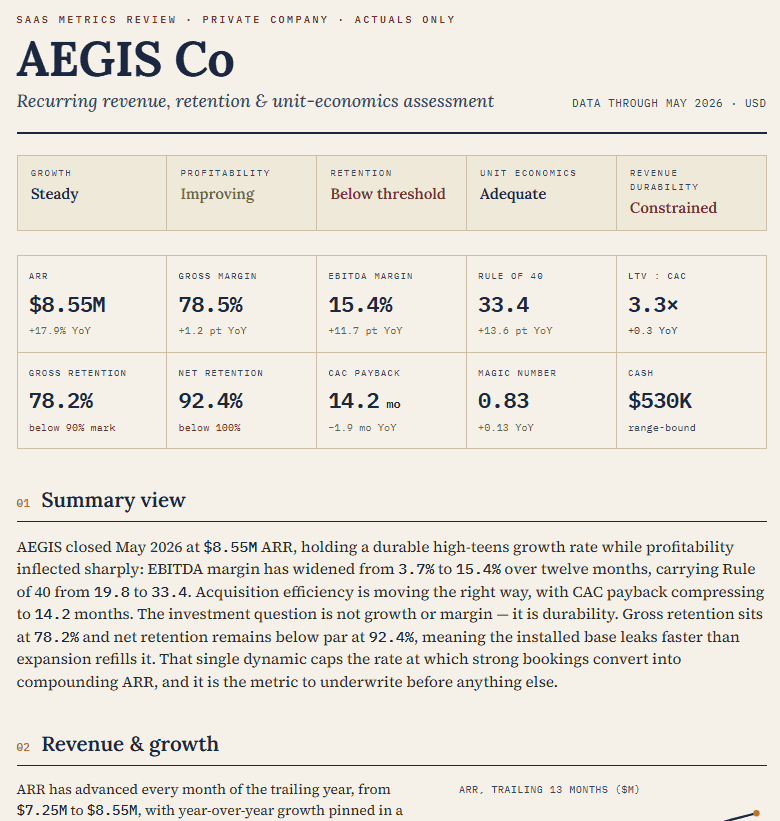
The sample board update below was generated by Claude. I have an MCP/API feature in SoftwareMetrics.ai that lets you run analysis on top of well-structured data and deterministic outputs.
This is a pretty version, but I also had it run a Word doc version. You are only limited by your creativity. I trust the outputs in this report. Now, it’s my job to edit the narrative.
The right data – structured data – well-defined formulas – deterministic output – AI analysis
References
- Fortune, “Cisco is rolling out AI agents to every single one of its 90,000 employees,” July 1, 2026.
- Cisco Systems, Q2 FY2026 earnings call transcript, February 11, 2026.
- Cisco Systems, Q3 FY2026 earnings call transcript, May 13, 2026.
- KPMG, 2026 Global AI in Finance: The Decision Advantage, May 2026.
- Consero, 2026 CFO Survey, May 2026.
- Deloitte, CFO Signals Survey, Q4 2025.
- SEC Investor Advisory Committee, Recommendation on the Disclosure of Artificial Intelligence’s Impact on Operations, December 4, 2025.
- SEC Petition for Rulemaking, File No. 4-882, February 9, 2026.

I have worked in finance and accounting for 25+ years. I’ve been a SaaS CFO for 9+ years and began my career in the FP&A function. I hold an active Tennessee CPA license and earned my undergraduate degree from the University of Colorado at Boulder and MBA from the University of Iowa. I offer coaching, fractional CFO services, and SaaS finance courses.