In one week, August 4 to 7, 2026, two software companies told investors the same story from opposite ends of the AI COGS spectrum.
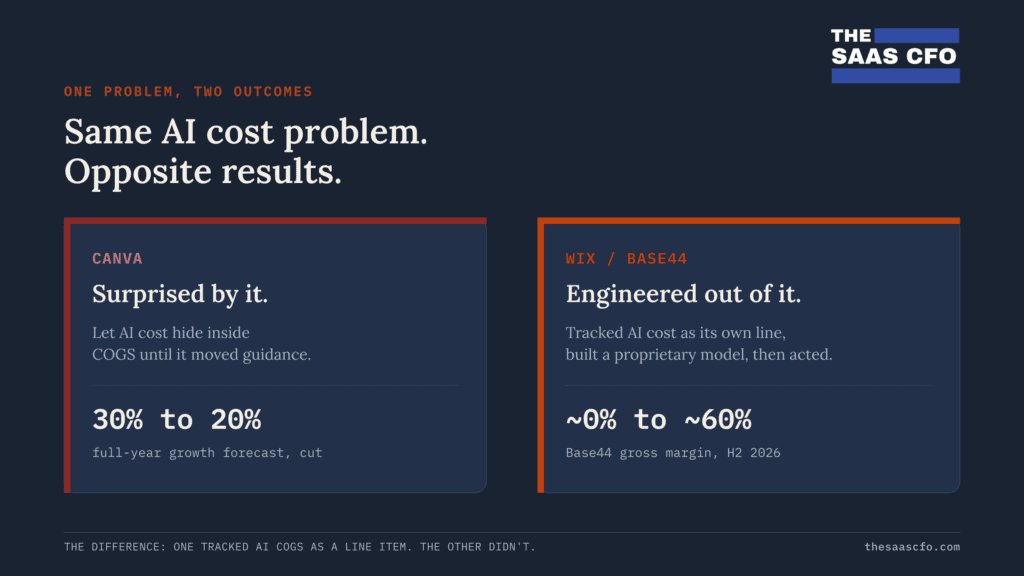
Canva cut its full-year 2026 growth forecast from 30% to 20% and said that the cost of serving an AI task had gotten too high. Love the honesty, Canva. Wix said its AI product went from near-zero gross margin to about 60% in half a year, by building its own model.
Same underlying problem. Opposite outcomes.
AI inference can be expensive, and it does not behave like the rest of your SaaS COGS. Canva got caught in the AI learning curve. Wix engineered its way out of it and is now reinvesting the savings into growth.
The difference was not luck. One company tracked AI unit economics as a distinct line, with its own margin and its own cost drivers. The other buried it inside COGS until the number got big enough to move guidance.
If you cannot tell your board what an AI feature costs per user/customer or per task or per outcome, you have the same blind spot Canva just disclosed. This is the framework to fix that, with Canva, Wix, and Atlassian as the case studies.
The Canva Warning Shot
Canva’s Q2 2026 numbers looked fine on the surface. Revenue of $921.9 million, up 25.2% year over year. But that missed the company’s own guidance, and the forward-looking part is where it got interesting. Canva cut its full-year 2026 growth forecast from 30% to 20%. That is a ten-point haircut on a company doing about $4 billion in ARR per cited sources.
In Canva’s Q2 CY2026 letter to shareholders, CEO Melanie Perkins wrote that the company had been “relying too heavily on frontier models.” Canva was routing too much AI traffic through expensive third-party models because its own models were not ready. It chose to slow the rollout rather than ship AI features at unit economics it could not sustain.
This is a company valued at about $42 billion, profitable for years, with more than $1 billion in cash, saying it got its AI cost model wrong at scale. Not a startup burning venture money on inference. A mature, profitable platform that let AI COGS run ahead of its ability to price and manage it. But we can’t be too harsh here. We are all on the frontlines of this. They are a big company, though.
Note the structure. Canva is private, so there was no stock to punish. The signal came from its shareholder letter, not a public filing, which means the numbers here are drawn from that letter as reported by the financial press rather than from a public disclosure. That makes it easier to miss in the headlines, and more instructive, because the discipline was internal, not forced by the market.
The fix is the lesson. Canva rebuilt its AI infrastructure and reports about a 90% reduction in cost per AI task. The new architecture routes free-tier users to Canva’s own cheaper models and reserves frontier-model access for paid tiers, where the unit economics may support it. It also sells an AI Pass add-on at $100 per user per month, stacked on top of Pro and Business, to isolate heavy AI usage into its own price point.
The CFO lesson. None of that, the routing, the tiering, the AI Pass, was possible until Canva could see AI cost per user and per task separately from everything else in COGS. Let’s learn from Canva and build our AI COGS tracking today.
The Wix Playbook
Wix is the mirror image. Base44, its AI no-code app builder, entered 2026 with near-zero non-GAAP gross margin. Every app a user built was consuming inference at close to what Wix charged for it.
In June 2026, Wix launched Base 1, a proprietary model built to run Base44’s workloads instead of routing through third-party frontier models. By the Q2 2026 call, management guided Base44 gross margin to about 60% in the second half. That is a swing of that size in about six months. Company-wide, Wix expects to add about two points to consolidated non-GAAP gross margin, second half versus first half. Two points at Wix’s scale is real money.
CFO Lior Shemesh put it directly: “The deployment of Base 1 marks a turning point in lowering our AI inference and compute costs.” Notice what Wix did with the savings. Management said it is reinvesting into sales and marketing and raising its target return on investment, using the newly found margin to fund growth rather than dropping it to the bottom line.
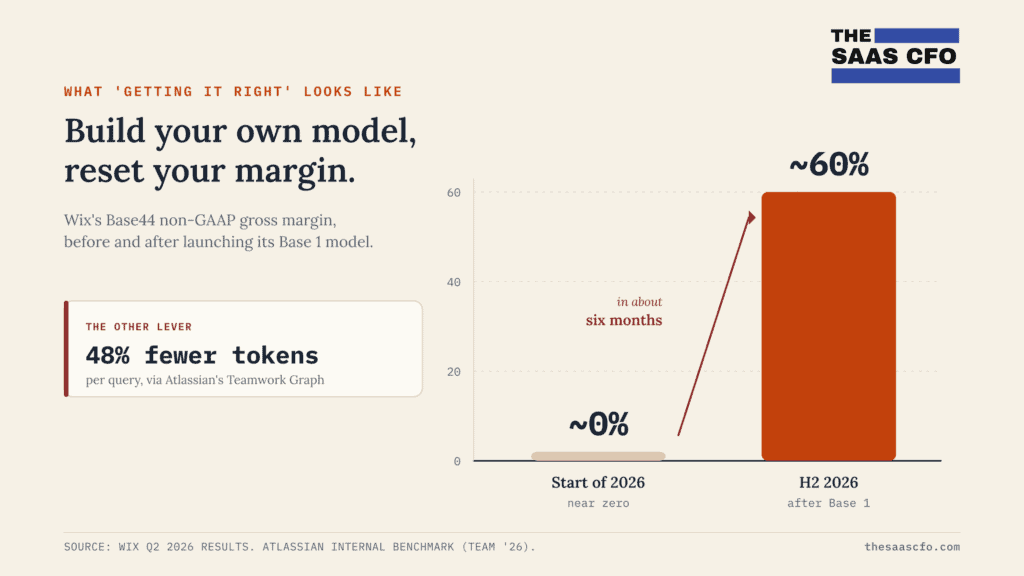
One honest caveat for your own read. Wix’s consolidated non-GAAP gross margin still came in at 67% in Q2, and that was down about three points year over year, because Base44 and AI compute weighed on the blended number even as Base44’s own margin climbed.
The CFO lesson. Wix could only make the reinvest-versus-bottom-line decision because it had Base44’s economics tracked as a discrete, visible unit, separate from core Wix. You cannot make a deliberate choice about a cost you cannot isolate. I’ve been teaching this in the SaaS Metrics Foundation for years. The separate line is what enabled the strategic call. Margins by revenue stream; it never goes out of style.
The Bonus Case: Atlassian
Canva and Wix both show the isolate-the-cost-then-decide playbook. Atlassian shows a third option. Make your existing architecture do the cost-cutting for you.
Atlassian passed 5 million monthly active users of Rovo, its AI layer, and reported AI credit usage growing more than 20% month over month in its Q3 FY26 results. That is aggressive adoption. And yet its non-GAAP gross margin held at about 89%. On its Q2 FY26 earnings call, CEO Mike Cannon-Brookes said the company can “manage those AI costs inside for the vast majority of customers.” That is a company saying it does not need a separate AI tier for most users, because the cost structure already supports it.
The mechanism is the Teamwork Graph, Atlassian’s structured data layer across Jira, Confluence, and its other products. Because Rovo can pull pre-structured context from the graph instead of guessing at it, Atlassian’s own internal benchmarks, published at its Team ’26 event in May 2026, claim 44% more accurate answers while using 48% fewer tokens per query. Treat those as vendor-reported numbers, not independently verified.
But the direction is what matters. Fewer tokens per query is a direct reduction in inference cost. This circles back to a Salesforce earnings call and Agentic Work Units. Customers get more bang for the inference buck and your gross margin appreciates it, too.
The CFO lesson. The more structured, relevant context you can feed a model, the fewer tokens it burns to get a good answer. I’ve learned this building SoftwareMetrics.ai. If your product already has rich, structured customer data, that data is an AI cost advantage. This is an R&D conversation as much as a finance one.
Why You Need a Separate AI COGS Line
Three companies, three outcomes, one root cause. The starting point in every case was visibility into AI cost as its own number. I teach this in my AI Metrics course.
Four reasons that line matters.
- Board visibility: costs buried inside COGS do not trigger the questions they need to.
- Pricing: you cannot price an AI feature if you do not know what it costs per user or per task, and Canva’s $100 AI Pass only makes sense because they now know the cost it has to cover. Check my cost distribution ratio lesson.
- Build versus buy: both Canva and Wix moved to proprietary models to control inference, and you cannot evaluate that trade without isolated cost data. That’s my next step for my business. Not building my own model but running open source models on my server.
- Margin attribution: some AI features are accretive, others destroy margin while looking like growth, and you will not know which is which without COGS detail.
How to Set It Up
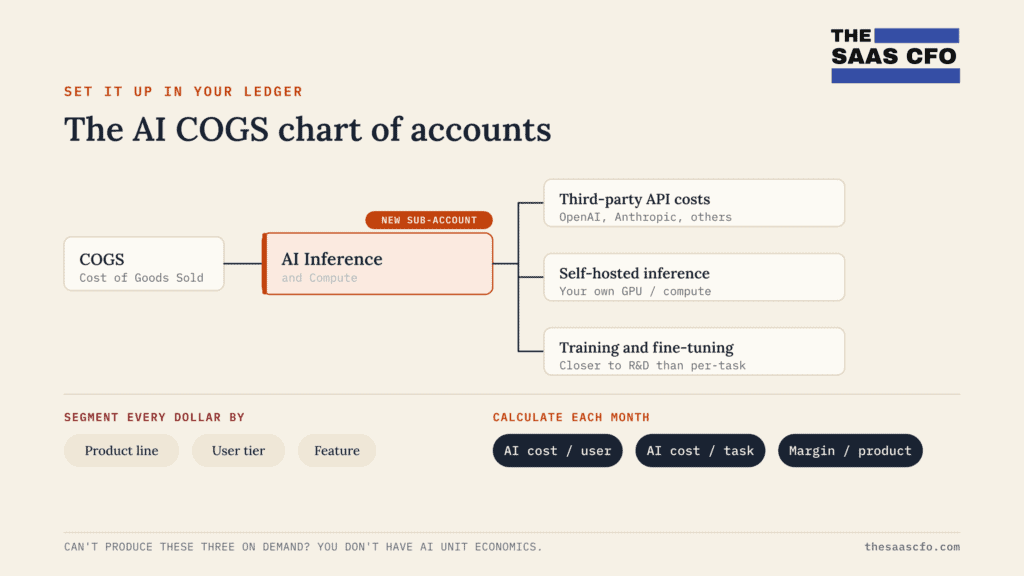
Create a GL account under COGS called AI Inference and Compute. Underneath it, track third-party API costs, self-hosted inference compute, and model training and fine-tuning separately. Keep training out of per-task cost. It behaves more like R&D.
Then segment that spend three ways. By product line, the way Wix separates Base44 from core Wix. By user tier, the way Canva separates free from paid routing. By feature, so you know which AI features consume the most compute and whether they are the ones driving retention or upgrades. Check out my AI COGS post for more details.
From there, calculate three numbers every month. AI cost per user. AI cost per task. AI gross margin by product. If you cannot produce those three on demand, you do not have AI unit economics. You have a big bucket of AI expenses. Inference Efficiency Ratio is also a metric you can track today.
Of course, this may require some dimesionality in your chart of accounts. A couple GL accounts won’t solve it all. You will probably need track customer level tracking in your product and/or inference environments.
Pick One of Three Responses
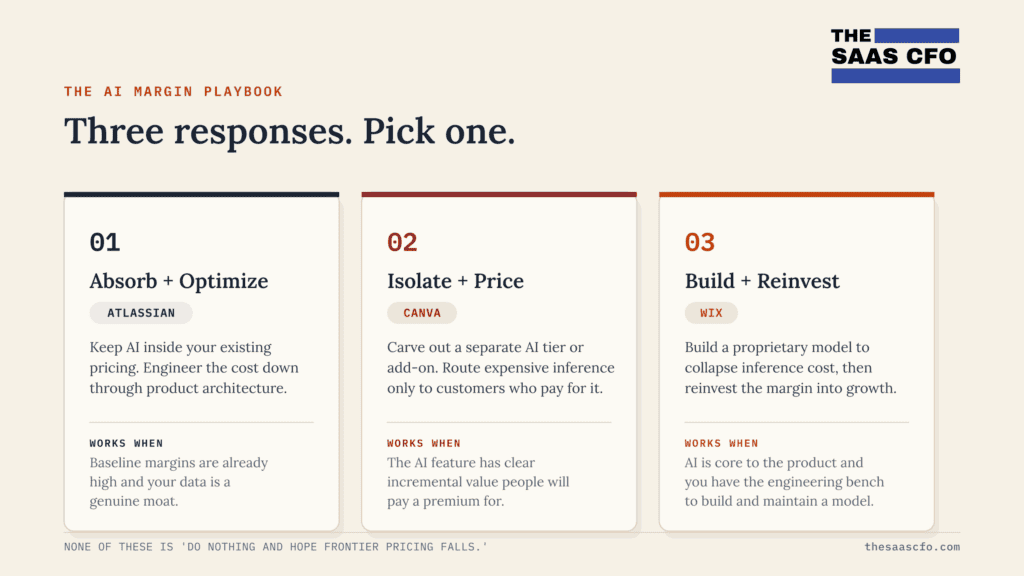
Absorb and optimize, Atlassian’s path. Keep AI inside your existing pricing and engineer the cost down through architecture. This works when your baseline margins are already high and your data is a genuine moat.
Isolate and price, Canva’s pivot. Carve out a separate AI tier or add-on and route expensive inference only to customers paying for it. This works when the AI feature has clear incremental value customers will pay a premium for.
Build and reinvest, Wix’s move. Invest engineering into a proprietary model to decrease inference costs, then deliberately reinvest the margin gain into growth. This works when AI is core to the product and you have the bench to build and maintain a model.
The Bottom Line
The companies winning the AI margin game are not the ones spending the most on AI. They are the ones who know exactly what they are spending, where, and why, down to the user and SKU. Every one of the three now tracks AI economics as a separate line, with its own margin and its own decisions attached.
If your AI costs are still sitting inside a blended COGS / Dev Ops number, you are running margin blind. The fix is new AI GL accounts, working more closely with R&D on inference tracking, and a decision about which playbook fits.
This framework, including the chart-of-accounts setup and the AI margin dashboard template, is part of the AI unit economics module inside The SaaS Academy. If you are building an AI feature and want the hands-on version, it is in there.
Sources
Canva. Q2 CY2026 letter to shareholders (Melanie Perkins). Canva is a private company and files no public results, so the figures cited here, including revenue of $921.9 million up 25.2%, the 30% to 20% forecast cut, the about 90% cost-per-task reduction, and the $100 per user AI Pass, come from that letter as reported by the financial press, including the Australian Financial Review and Startup Daily. The cash position (about $1 billion) and profitability history should be treated as approximate, since sources vary.
Wix. Q2 2026 results, reported August 4, 2026 (SEC Form 6-K and company press release), and the Q2 2026 earnings call. Sources for the near-zero to about 60% Base44 gross margin, the June 2026 Base 1 launch, the 67% consolidated non-GAAP gross margin, and the Lior Shemesh quote.
Atlassian. Q3 FY26 results, reported April 30, 2026 (SEC Form 8-K and earnings release), for the about 89% non-GAAP gross margin and the 20%-plus month-over-month credit growth. Q2 FY26 earnings call (February 2026) for the 5 million Rovo users and the Cannon-Brookes cost-management quote. Team ’26 event (May 2026) for the 44% accuracy and 48% token-reduction benchmarks, which are Atlassian’s own internal figures.

I have worked in finance and accounting for 25+ years. I’ve been a SaaS CFO for 9+ years and began my career in the FP&A function. I hold an active Tennessee CPA license and earned my undergraduate degree from the University of Colorado at Boulder and MBA from the University of Iowa. I offer coaching, fractional CFO services, and SaaS finance courses.