Many SaaS CFO’s I talk to are dealing with the same problem whether they have named it yet or not.
Their nascent 2026 AI budgets, most of which were set last October, are already blown. And they have not started planning for 2027.
When budget season opens this fall, finance leaders will walk into something we have not seen in twenty years. Every department will want more AI spend. The bills from existing AI tools are running several times higher than anyone projected. Total IT budgets are growing around 3.5%. The math does not work. Something has to give.
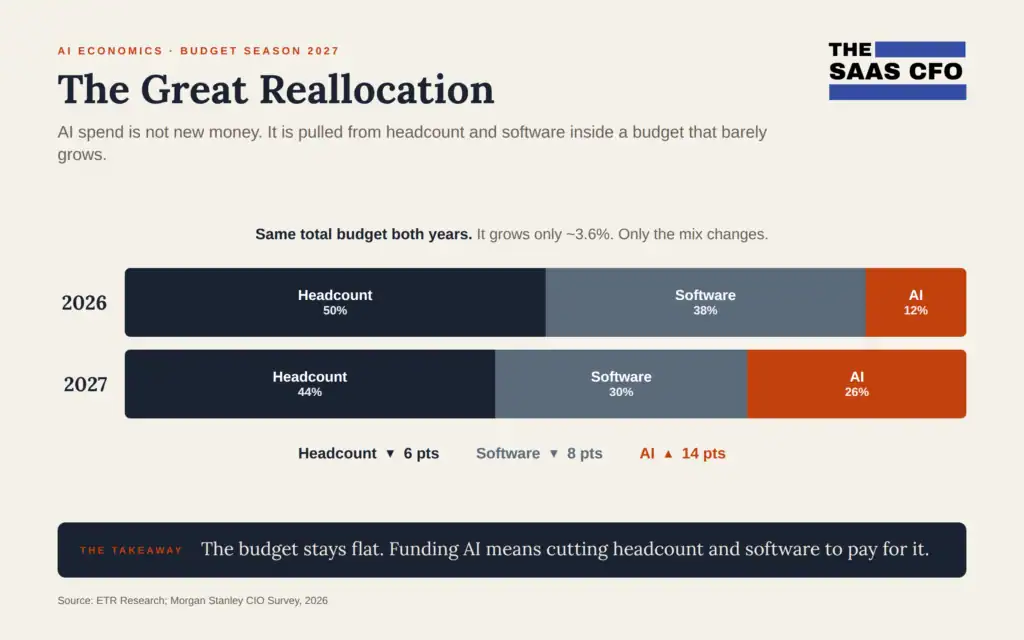
I think this fall will produce a great reallocation. Money moves between three buckets that used to grow on separate tracks: headcount, AI, and software. And one track did not exist. For the first time, they are competing for the same dollar. And most SaaS companies are not ready to answer the questions their boards and investors are about to ask.
Here is what is happening, why it matters, and what I would do about it right now. The great reallocation is coming.
The AI Spending Problem is Already Here
Start with the numbers, because they are hard to argue with.
Uber blew through its entire 2026 AI coding budget by April. Not half of it. All of it. The disclosure came from Uber’s CTO, who told The Information the budget he had planned for was already gone. Uber’s response was to cap spending at $1,500 per employee per tool each month, tracked through an internal dashboard. That cap applies to each agentic coding tool separately, so an engineer can spend $1,500 on Claude Code and another $1,500 on Cursor.1
An AI consultant told Axios that one enterprise client ran up a $500 million bill from Anthropic in a single month after giving employees unrestricted access with no usage caps. That figure is one consultant’s account, and no company has confirmed it. But the pattern it describes is real.2
Microsoft pulled Claude Code from thousands of engineers in its Experiences and Devices division and moved them to its own GitHub Copilot CLI. The reporting frames this mostly as strategy, not cost. Claude Code had become popular enough internally that it was displacing the product Microsoft sells to everyone else. The fiscal year timing suggests cost played a role too. Either way, the cost lesson lands hard. Even the company selling AI coding tools decided unlimited internal access did not pencil out.3
Priceline saw a routine Cursor renewal come back four to five times more expensive than the prior term.4
These are not outliers. The FinOps Foundation reports some companies are running 3x over their full-year token budgets as early as April. Jellyfish told TechCrunch that per-developer AI consumption rose about 18.6x in nine months. Ramp reports the average business now spends 13x more on AI tokens than in January 2025, with token usage up roughly 1,001% over that span.45
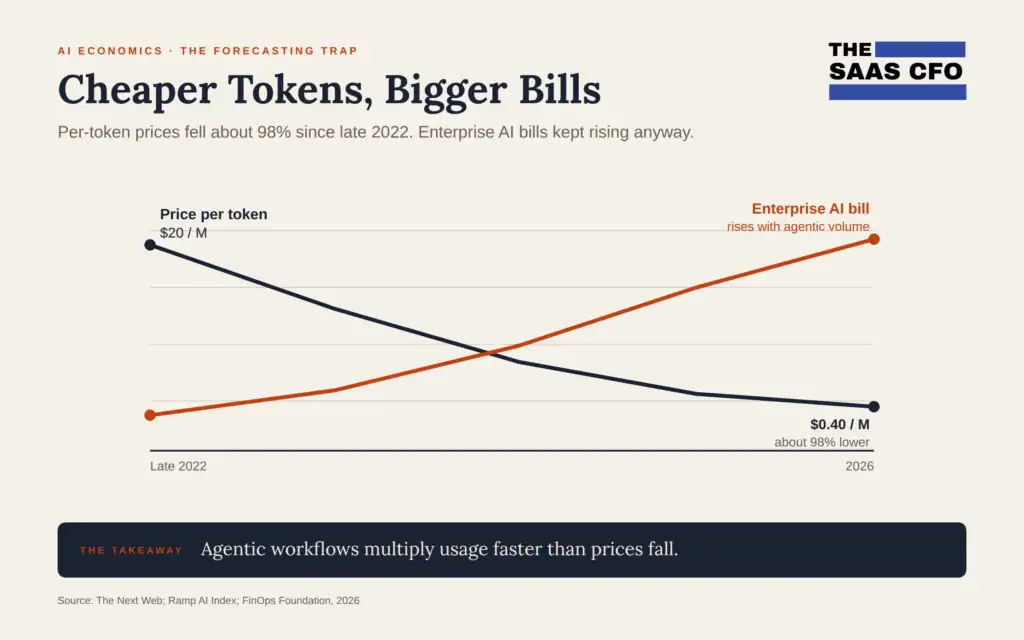
Here is the paradox that makes this so hard for FP&A teams to forecast. Per-token prices have fallen about 98% since late 2022. GPT-4-level output that cost around $20 per million tokens now costs closer to $0.40. Yet enterprise AI bills keep climbing. Cheaper per unit. Far more expensive overall.6
The reason is the shift from simple chatbots to agentic systems. And that prompt to fix the prior prompt costs money. One illustrative estimate puts a basic AI query in 2023 at about $0.04 and an orchestrated agentic workflow in 2026 at roughly $1.20, around 30 times more. When every developer and analyst runs multi-step agents that loop through dozens of actions per task, volume explodes faster than price falls.6
The AI Budget Math that Breaks This Fall
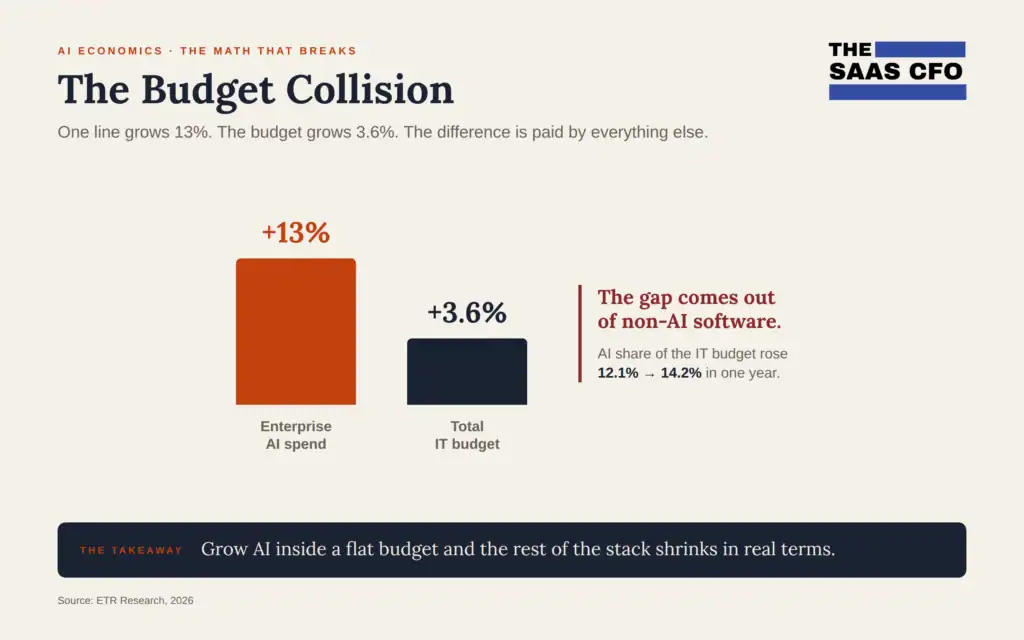
IT budgets are growing about 3.4% to 3.6% year over year, per Morgan Stanley and ETR. That is essentially flat.
Now look at where AI sits inside that flat number. ETR’s data shows AI’s share of IT budgets rising from 12.1% to 14.2% in a single year, with enterprise AI spend growing around 13%. You cannot grow one line at 13% inside a budget growing at 3.6% without squeezing everything else. That is reallocation, not addition.7
Globally, the picture is even more lopsided. Gartner now projects worldwide AI spending will rise 47% in 2026, revised up from 44% earlier in the year. Most of that global figure is infrastructure and data-center buildout, not enterprise software budgets. But it tells you which way the gravity points.8
The Redpoint Ventures survey of 141 CIOs is where the reallocation becomes concrete. 45% say their AI budgets are coming straight out of existing software line items, not new money. 54% are running active vendor consolidation programs. Only 3% expect AI to lead to more vendors overall. Read those three numbers together and you have the whole story. AI is not opening new budget. It is forcing a harsh re-ranking of what vendors stay in the stack.9
SaaStr sized the shift bluntly. Anthropic and OpenAI together now pull $40 billion to $50 billion a year from enterprise budgets, spend that barely existed two years ago. That is 5% to 6% of the entire enterprise software market redirected to two companies. The market has noticed. Public SaaS multiples have compressed from about 22x forward revenue in 2021 to roughly 4.1x today. Investors are pricing in permanent pressure on growth.910
The Returns Aren’t There Yet
Here is the part that should worry every finance leader heading into budget season.
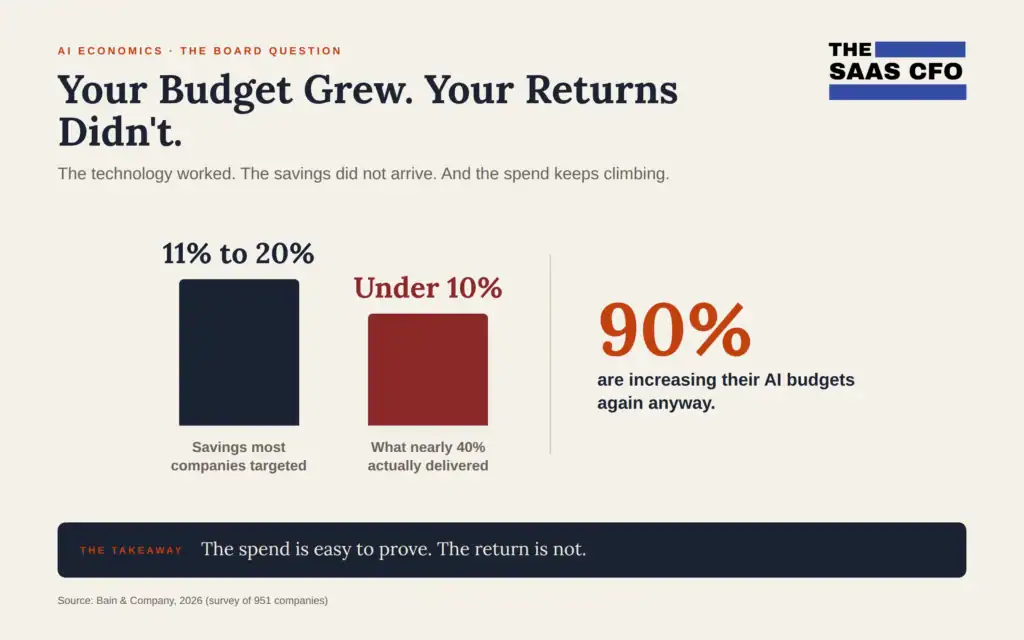
Bain surveyed 951 companies. Among those that measured AI cost savings, nearly 40% landed below 10% costs savings, even though most had targeted 11% to 20% savings. The technology worked. The value did not show up. And 90% of those same companies are increasing their AI budgets again anyway.11
It gets riskier. 44% of companies say they are funding their next wave of AI from prior automation savings. Savings that, for many CFO’s, never fully materialized. If your last AI program delivered 60% of its target, you are sizing the next one on money you did not actually save.11
This is the question your board is going to ask. Not “how much did we spend.” It is “what did we get.” Most SaaS companies cannot answer it cleanly today. It used to be tokenmaxxing and showing off your Anthropic bill. Those days are gone.
What Has to Give
When CFOs build 2027 plans this fall, three things get squeezed.
Traditional SaaS gets cut. This is already happening. CIOs are reducing or canceling existing contracts to fund AI. Horizontal productivity tools, workflow automation, and any tool a buyer sees as the fourth option in a crowded category are the most exposed. If an agent can do what three subscriptions used to do, those three get reviewed hard.
AI spend gets governed. The blank-check era is over. Expect per-user and per-tool caps, mandatory ROI cases before approval, and procurement moving AI buying authority from engineering to finance. Gartner calls 2026 a “trough of disillusionment” year and expects more than 40% of agentic AI projects to be canceled by the end of 2027. ROI has to be proven before anything scales.8
Headcount expansion slows. Gartner’s data shows headcount growth expectations collapsing from 6% in 2025 to 2% in 2026. Only 21% of CFOs plan staff increases of 4% to 9%, down from 31% last year. This is not mass layoffs. It is quieter. 42% of CFOs expect some AI-driven headcount reduction in support functions, and most of that sits in the 1% to 5% range. AI is not emptying the building. It is replacing the next hire that would have been approved.12
What I Would Do Before Budget Season
If you are a SaaS CFO or finance leader, here is what I would be doing now, not in October.
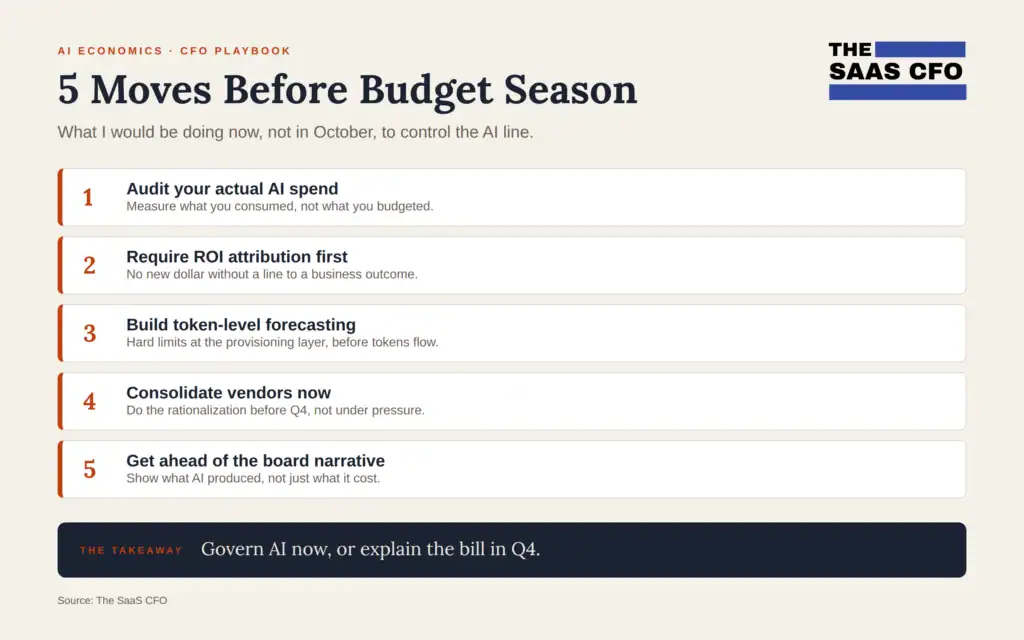
Audit your actual AI spend. Not what you budgeted. What you actually consumed and by vendor. Most companies cannot answer this today because AI costs hide across IT budgets, department P&Ls, and shadow subscriptions procurement never approved. Two years ago, 31% of FinOps practitioners managed AI costs. In 2026, that figure is 98%. If you are not in that 98%, you are flying blind.13
Require ROI attribution before the next dollar. Bain found 44% of companies funding new AI from prior savings that often came in under target. Size your next investment against what your last one actually returned, not what it was supposed to return.11
Build token-level forecasting. Cloud cost tracking already deals in hundreds of millions of rows a month. Token cost tracking deals in trillions. Your cloud tools were not built for that. You need hard limits at the provisioning layer, enforced before tokens flow up and over limits, not flagged after the invoice lands. CFO’s won’t be happy if you hand this to them next year.
Consolidate vendors now. If 54% of CIOs are already consolidating, you do not want to negotiate in Q4 when every vendor knows you are under pressure. Do the rationalization work now. Find the overlap. Cut what cannot prove its value.
Get ahead of the board narrative. AI spend is now large enough to move EBITDA. It is not a rounding error. Your board will ask. Have the dashboard ready, and not just what you spent. What it produced. If you cannot draw a straight line from AI cost to business outcome, that is the first problem to solve.
The Bottom Line on AI Spend
The reallocation is not theoretical. It is already here for Uber, Microsoft, and Priceline. It just has not hit most planning cycles yet.
This fall, finance teams will sit down to build 2027 budgets and find that AI has become the most volatile, least predictable, most political, and hardest-to-govern line in the entire technology stack. The companies that started governing it six months ago will be fine. The ones that treated it as an experiment with no financial controls are walking into a very uncomfortable Q4 and budget board meeting.
The CFO’s job in AI just changed. It is no longer about approving the spend. It is about proving the return.
Want to learn more AI metrics? Check out my AI Finance and Metrics training program here.
Sources and Footnotes
- “Uber caps employee AI spending after blowing through budget in four months.” TechCrunch, citing Bloomberg and The Information, June 2, 2026. https://techcrunch.com/2026/06/02/uber-caps-employee-ai-spending-after-blowing-through-budget-in-four-months/ ↩
- AI consultant account reported by Axios, May 28, 2026. Corroborated in “The token bill comes due.” TechCrunch, June 5, 2026. https://techcrunch.com/2026/06/05/the-token-bill-comes-due-inside-the-industry-scramble-to-manage-ais-runaway-costs/ ↩
- The Verge (Tom Warren), reported May 14, 2026, via Windows Central. https://www.windowscentral.com/microsoft/microsoft-cancels-claude-code-licenses-shifting-developers-to-github-copilot-cli-a-move-likely-driven-by-financial-motives ↩
- “The token bill comes due: Inside the industry scramble to manage AI’s runaway costs.” TechCrunch, June 5, 2026 (Priceline renewal, Jellyfish 18.6x, FinOps 3x figure). https://techcrunch.com/2026/06/05/the-token-bill-comes-due-inside-the-industry-scramble-to-manage-ais-runaway-costs/ ↩ ↩2
- Ramp AI Index, “The $1 trillion AI spend blind spot,” April 2026 (13x token spend since January 2025; ~1,001% usage growth). https://ramp.com/blog/ai-token-cost-for-businesses ↩
- “Token prices fell 98%. Enterprise AI bills tripled.” The Next Web, June 2026 (98% price drop; illustrative $0.04 to $1.20 agentic workflow estimate). https://thenextweb.com/news/token-prices-fell-98-enterprise-ai-bills-tripled-now-the-industry-wants-a-standards-body-to-explain-why ↩ ↩2
- “Where AI Money Comes From: The Quiet Shift Inside IT Budgets.” ETR Research, 2026 (AI share of IT budgets 12.1% to 14.2%; ~13% AI spend growth; IT budget growth ~3.6%). https://research.etr.ai/etr-data-drop/where-ai-money-comes-from-the-quiet-shift-inside-it-budgets ↩
- “Gartner Forecasts Worldwide AI Spending to Grow 47% in 2026.” Gartner, May 19, 2026 (revised up from the 44% January forecast; trough of disillusionment; >40% of agentic projects canceled by end of 2027). https://www.gartner.com/en/newsroom/press-releases/2026-05-19-gartner-forecasts-worldwide-ai-spending-to-grow-47-percent-in-2026 ↩ ↩2
- Redpoint Ventures 2026 State of the Market (n=141 CIOs: 45% from existing software, 54% consolidating, 3% expect more vendors; public SaaS multiples ~22x to ~4.1x). Via SaaStr, March 2026. https://www.saastr.com/redpoint-latest/ ↩ ↩2
- “How Much of the Software Slowdown Is Just Budgets Flowing to Anthropic and OpenAI?” SaaStr, March 16, 2026 ($40B to $50B annually; 5% to 6% of enterprise software market; Morgan Stanley CIO survey IT budget 3.5% to 3.4%). https://www.saastr.com/how-much-of-the-software-slowdown-is-just-budgets-flowing-to-anthropic-and-openai-maybe-as-much-as-70/ ↩
- “Your AI Budget Is Growing. Your Returns Aren’t. Here’s Why.” Bain & Company, June 2026 (n=951: ~40% below 10% savings vs 11% to 20% target; 90% increasing anyway; 44% funding from prior savings). https://www.bain.com/insights/your-ai-budget-is-growing-your-returns-arent-heres-why/ ↩ ↩2 ↩3
- “Gartner Research Reveals CFOs’ Budget Plans Prioritize Growth Functions, Technology and AI in 2026.” Gartner, February 10, 2026 (headcount growth 6% to 2%; 21% planning 4% to 9% staff increases, down from 31%). Headcount reduction figures (42% expecting some AI-driven reduction, mostly 1% to 5%) from Gartner’s 2026 Budget Assumptions survey, October 2025. https://www.gartner.com/en/newsroom/press-releases/2026-02-10-gartner-research-reveals-cfos-budget-plans-prioritize-grotwth-functions-tech-and-ai-in-2026 ↩
- State of FinOps 2026, FinOps Foundation (a Linux Foundation program), February 19, 2026 (AI cost management: 31% in 2024, 63% in 2025, 98% in 2026; n=1,192). https://www.finops.org/ ↩

I have worked in finance and accounting for 25+ years. I’ve been a SaaS CFO for 9+ years and began my career in the FP&A function. I hold an active Tennessee CPA license and earned my undergraduate degree from the University of Colorado at Boulder and MBA from the University of Iowa. I offer coaching, fractional CFO services, and SaaS finance courses.