
Most SaaS companies already have the data they need to understand their revenue base. It’s sitting in their billing system, invoice exports, MRR schedules, CRM, and financial statements.
The problem is not always more data.
The problem is structure and data coordination.
For years, we have used customer revenue data to build MRR schedules, ARR waterfalls, retention metrics, and board reporting. That work still matters. But with AI, we can now do more with the same data.
We can surface dormant ARR. We can score ARR durability. We can find expansion opportunities hiding inside the existing customer base. And we can turn the output into a CFO-ready narrative that explains what is happening in the business.
The Three Layers of AI in Finance
Layer 1: The SaaS finance data foundation
Before AI can be useful, your data must be structured. No surprise; we’ve known this since this the mainframe days. This is the part most AI product demos skip or the latest webinar focused only on AI prompts.
Four data sources matter. I talk about this in my blog at TheSaaSAcademy.com.
- Financial – data from your accounting software
- Customer – invoice and revenue data from your accounting or revenue management software
- CRM – closed won bookings data or data derived from the MRR waterfall if you are PLG or self-service SaaS
- HRIS – people and contractor data coded for wage and FTE reports and forecasting
If this layer is messy, AI will just produce a polished explanation of bad data. However, with clean data from these source, you can produce my 5 Pillar SaaS Metrics Framework (6 now with AI unit metrics) and an accurate FP&A process.
Layer 2: The deterministic layer
Once the data is structured, we calculate the metrics. MRR schedules, ARR waterfalls, retention, customer concentration, dormant ARR, segment performance, expansion history, and ARR durability all calculated through repeatable rules.
The same data should produce the same answer every time. When building SoftwareMetrics.ai. I had about 40 pages of specs that defined the formulas and periods of measurement. I didn’t prompt my way to automated SaaS metrics.
This matters because you need to defend the number. You need to explain the methodology and data sources. You need to show your board, CEO, or investor how the calculation works. AI is not guessing at your CAC Payback Period.
That is the difference between using AI responsibly in finance and letting AI become a black box.
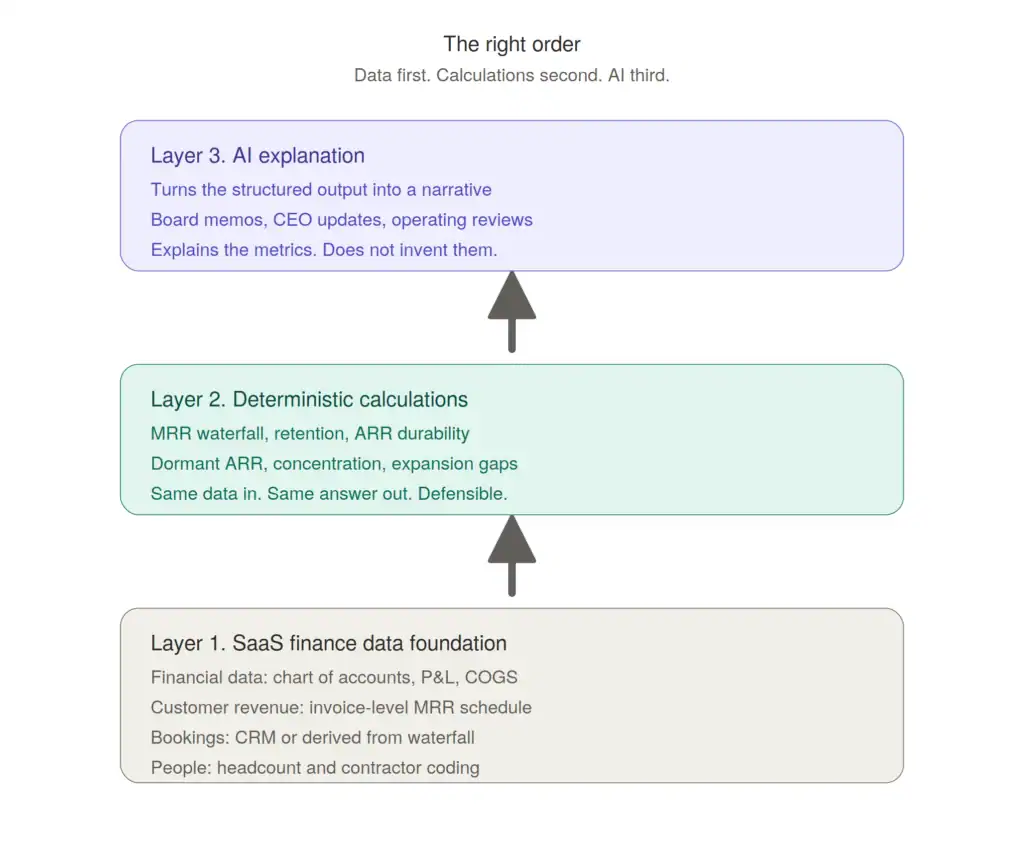
Layer 3: The AI layer
After the data is structured and the calculations are complete, AI becomes useful.
AI is not creating the metrics. It is explaining them. It’s pulling together 100’s or 1000’s of data points for more context. Computed data points.
The AI layer takes the structured output from my RevIntel feature in SoftwareMetrics.ai and turns it into an executive narrative. It explains why the ARR Durability Score moved. It summarizes dormant ARR. It surfaces expansion opportunities. It gives the CFO a starting point for a board memo, CEO update, or operating review.
This is where AI belongs in SaaS finance. Not replacing the foundation. Not replacing the calculations. Not replacing CFO judgment. Helping us move faster from data to insight to action.
What This Looks Like in Practice
Here is an example from a $5.8M ARR company we will call Test Co.
The headline ARR looks fine. Growth story intact. But once you run the customer revenue base through the three-layer architecture, a different picture emerges.
Feature 1: Dormant ARR
Dormant ARR is hiding in plain sight.
A customer may still be paying you. They may not have churned. They may not show up in a traditional churn report. But if they have not expanded, renewed cleanly, or shown meaningful revenue movement in a long time, that ARR may not be as healthy as it looks.
This matters because operators usually find churn after it happens. Dormant ARR gives us a way to look earlier.
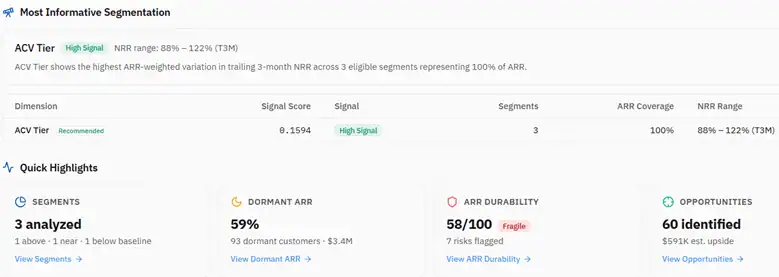
For Test Co, dormant ARR is $3.4M. That is 59% of active ARR sitting flat across 93 customers. The segment view tells the real story.
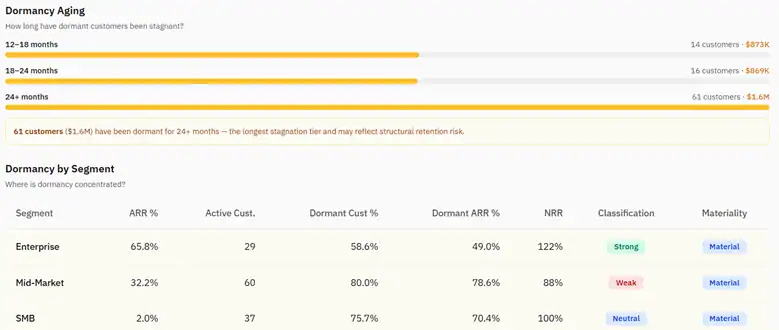
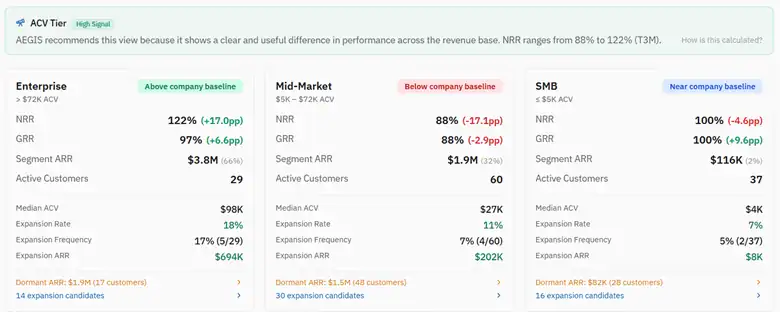
Enterprise is doing the heavy lifting. NRR is 122%. About half the ARR is dormant, but expansion in the active half is offsetting it.
Mid-Market is a different problem. 78.6% of mid-market ARR is dormant. NRR is 88%. There is no expansion offset. This is where churn is likely to show up next.
The invoice history was already there. The MRR schedule was already there. We are doing more with the same data. You could not produce this in Excel.
Feature 2: ARR Durability
Not all ARR is created equal. We’ve heard this for years. People talk about ARR durability but can’t really define what durable means beyond citing a retention number.
Two companies can have the same ARR and very different revenue quality. One has broad-based expansion, low churn, healthy renewal patterns, and low customer concentration. The other depends on a few large customers, recent bookings, and weak segments.
The headline ARR number does not tell you that story.
Acme SaaS Company’s ARR Durability Score is 58 out of 100. That puts it in the Fragile band. The score starts at 100 and gets penalized by seven deterministic risk checks.
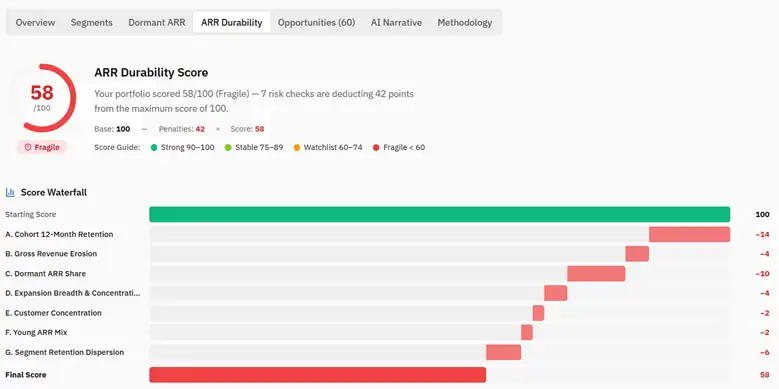
Each driver has logic behind it. The biggest issue at Acme is cohort retention. The second biggest is dormant ARR share. Segment retention dispersion is third, which lines up with what we just saw in the segment table.
This gives the CFO a much better board conversation. The headline is no longer “ARR grew.” The headline is “ARR is fragile, here are the three drivers, here is what we are doing about each one.”
That is a different meeting. This is a data-driven meeting that every Board member wants.
Feature 3: Expansion Opportunity Finder
The other side of revenue intelligence is growth.
Most SaaS companies spend a lot of time looking for new logo ARR. There is often expansion opportunity already sitting inside the existing customer base. The challenge is finding it. We know this has gotten harder for legacy B2B SaaS.
Opportunity Finder looks for customers under-monetized relative to similar accounts. If a customer is well below the median ACV for its segment, the segment shows good NRR, and similar customers are paying materially more, that is worth investigating.
For Acme, the engine flagged 60 expansion opportunities representing $591K of estimated upside ARR. On a $5.8M base, that is roughly 10% potential expansion identified without a single new logo.
This does not mean every account will expand. Finance logic does not replace sales judgment or customer context or product usage trends (good add to MRR data). But it gives the team a better starting point than “go mine the customer base.”
Same customer revenue data. New layer of intelligence on top.
What Changes for the Tech CFO
Once this foundation is in place, the week looks different.
Board prep starts from a durability score with named drivers, not a narrative the CFO has to construct from scratch.
The customer success conversation shifts from “who is churning” to “where is dormancy concentrated and is that segment expanding enough to offset it.”
The growth conversation has two inputs instead of one. New logo pipeline and quantified expansion upside in the existing base.
The diligence conversation, whether it is a board meeting, a fundraise, or an exit process, has structure behind every claim about ARR quality.
The work we have always done still matters. MRR schedules. Waterfalls. Retention. Board decks. Budget season.
We are just no longer stopping there.
Your MRR schedule has always told the story of your revenue base. With the correct data structure and a computed data layer, we can turbocharge our analysis with AI. The FP&A department in tech companies can do so much more.
Time to move on from prompts and get back to the real work, so that we are ready to scale with AI.
To learn more, you can check out SoftwareMetrics.ai. The app is also bundled with my SaaS Metrics Foundation course. You get the course for free when using the app.

I have worked in finance and accounting for 25+ years. I’ve been a SaaS CFO for 9+ years and began my career in the FP&A function. I hold an active Tennessee CPA license and earned my undergraduate degree from the University of Colorado at Boulder and MBA from the University of Iowa. I offer coaching, fractional CFO services, and SaaS finance courses.