For years, the SaaS revenue model was relatively simple.
Sell a subscription. Charge by the seat. Generate a monthly or annual invoice. Collect the cash.
SaaS finance has never been easy, but the underlying revenue engine was fairly predictable and simple.
AI did not break pricing ground here. Usage-based pricing is nothing new, but AI put the focus back on usage-based pricing.
Today, we have subscriptions, usage, credits, consumption tiers, overages, AI work units, and hybrid models that combine several of these onto one customer invoice.
Software pricing models are changing fast.
The finance infrastructure is trying to catch up.
That is my biggest takeaway from the 2026 CFO Signal Report, new research by Vayu in partnership with PwC and The SaaS CFO. The survey covered nearly 100 finance and operations leaders at B2B software companies.
And the data shows a clear gap forming between how software is priced and how Finance supports that pricing.
54% Have Moved Beyond Flat-Rate Pricing. Only 11.9% Can Support It.
The first number that jumped out at me was 54%.
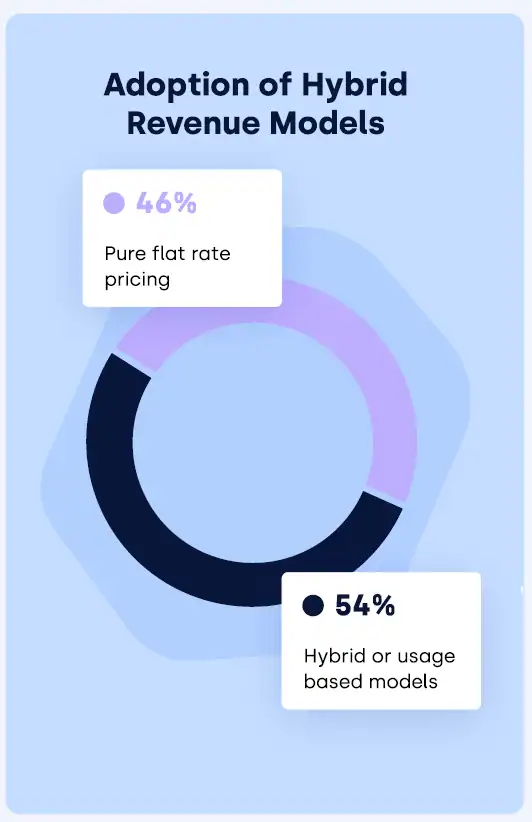
More than half of the companies surveyed now operate some form of hybrid or usage-based revenue model. Only 46% offer pure flat rate pricing. Depending on the survey you read, you’ll see different stats, but the point is the same.
Just 11.9% of finance teams say they have the automation to support their current pricing model.
Finance teams must be prepared for a lifetime of pricing model changes.
We changed the pricing model without changing the revenue infrastructure underneath it.
A seat-based subscription might only require customer, price, billing frequency, and contract dates. Even this is hard for a lot of finance teams.
A modern hybrid model could require customer usage, credits, minimum commitments, thresholds, overages, contract terms, and product data.
Finance must turn all of that into an accurate invoice, revenue data, a forecast, and ultimately clean financial statements.
Automation Isn’t Removing the Manual Work
This was probably my favorite finding in the report.
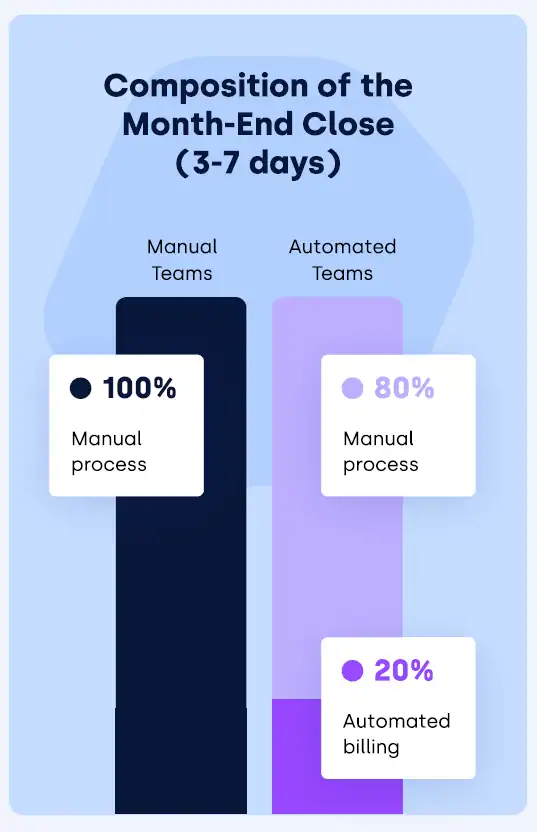
82% of finance teams still rely on manual spreadsheets during the month-end close. Wow.
And most close cycles remain stuck in the three to seven day range regardless of tool spend. But not sure that we can knock a 5 day or less close.
Here is the part that should get your attention. Even teams that invested in billing automation report that 80% of their close process is still manual. The tools automated a task, not the end-to-end process.
End-to-end automation is CFO utopia. It could be an old school term, but I call it “quote to cash.”
We automate one piece of the workflow, then export the data into Excel to reconcile it with another system. Your close life is miserable.
The report calls this the Automation Paradox: point solutions move the bottleneck rather than removing it.
That is an important distinction for CFOs evaluating the finance tech stack. More software does not necessarily create more leverage.
The question is whether the data flows cleanly from product usage to billing to accounting to reporting. And the original customer contract details the required inputs for accounting to set up the contract correctly.
Revenue Leakage Is a Margin Problem
The financial impact gets even more interesting.
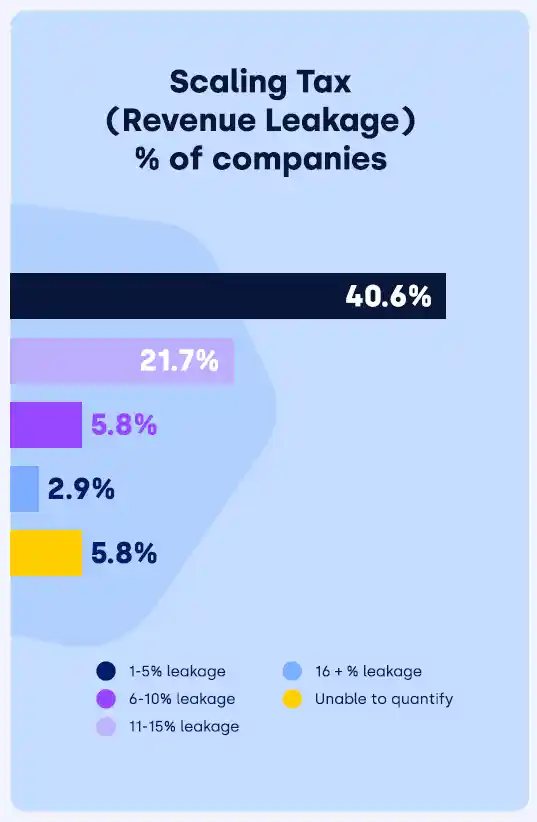
71% of companies surveyed report measurable revenue leakage.
Over 30% are losing more than 5% of annual revenue. Another 6% cannot quantify their leakage at all, which means they are flying blind on revenue integrity. The missed invoices are found by mistake. Happens to all of us.
Think about that from a CFO perspective.
We already acquired the customer. Sales and marketing expense has been incurred. The product was delivered. The customer consumed the service.
And then we fail to capture the revenue.
That is painful. As the report puts it, leakage is the most expensive form of churn because it happens after the cost of acquisition has already been paid.
This is why billing infrastructure is no longer just a back office accounting issue. It directly affects gross margin, cash flow, and the economics of the business. Closing the leakage gap is one of the fastest ways to improve margin without adding a single new customer.
Don’t despair yet. CFO’s are benefitting from the billions of VC dollars invested in back office infrastructure.
Finance Has Become an Internal Customer of Engineering
Another number stood out: 39% of finance teams report moderate to heavy dependency on Engineering to execute pricing and billing logic.
The report estimates that this complexity can consume up to 60 hours of engineering time per month.
If Finance needs a Jira ticket every time the company changes a pricing rule, adds a usage tier, or modifies billing logic, you do not have pricing agility. You have a system of band-aids.
Your GTM team may want to experiment quickly. Finance pushes back.
That eventually becomes a growth constraint.
Usage Pricing Doesn’t Mean Less Predictability
Here is the counterintuitive finding.
You might assume that usage-based pricing makes forecasting more difficult.
The data suggests otherwise.
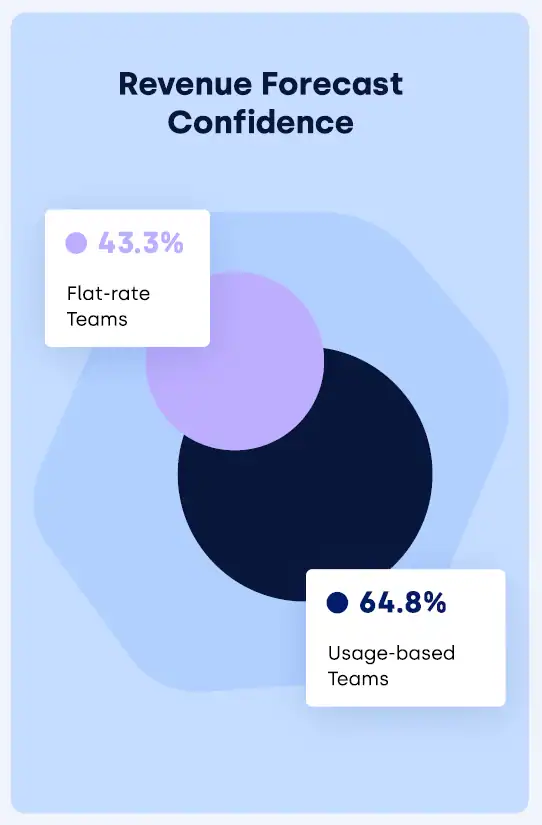
65% of usage-based teams said they were confident in their revenue predictability versus 43% of flat-rate teams. Usage-based teams were about 50% more likely to be confident in their forecast. Meanwhile, over 56% of flat-rate companies reported feeling neutral or not confident about their revenue predictability.
Why?
Because usage-based businesses are forced to build better visibility into customer behavior. Tracking consumption events for billing create enhanced data visibility that seat-based models never required.
That is the bigger lesson.
Predictability comes from the customer data pipeline, not the pricing model.
What Should SaaS CFOs Do Now?
Here is how I would attack this, in order.
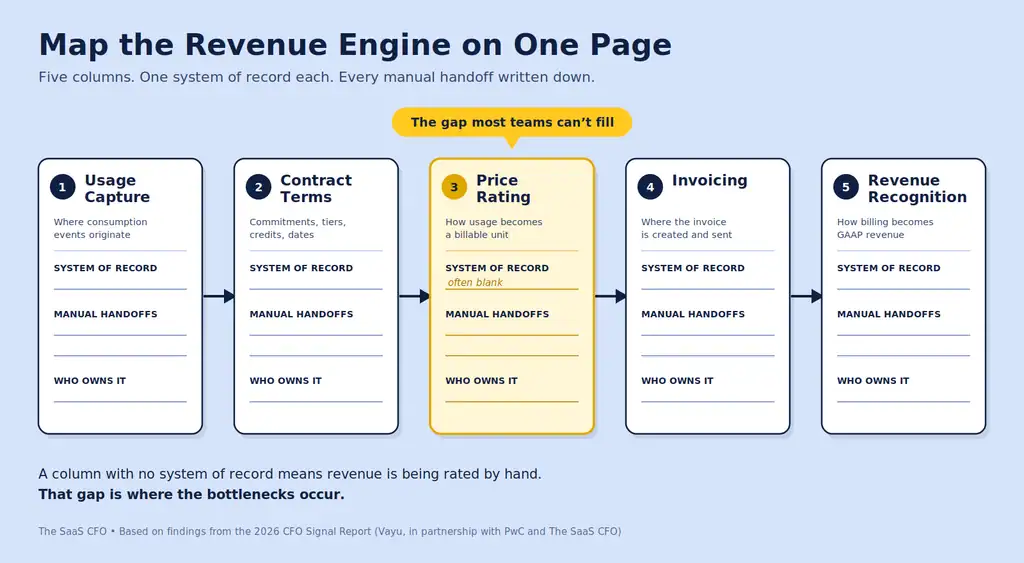
1. Map the revenue engine on one page.
Draw five columns: usage capture, contract terms, price rating (how usage becomes a billable unit), invoicing, and revenue recognition. Under each column, write down the system of record and every manual handoff between them. Most teams discover they cannot fill in the rating column. That gap is where bottlenecks occur.
2. Count your CSVs.
During your next close, count every manual export and re-import between systems. Each one is a reconciliation point, an error risk, and a breaking point. This number is a better health metric for your finance stack than your tool count. If the number goes up when you add software, you bought a point solution, not a process fix.
3. Quantify your leakage before you buy anything.
Pull a sample of 5 usage-based or hybrid contracts. Re-rate the actual consumption against the contract terms by hand and compare to what was invoiced. If you find gaps, extrapolate. With 71% of companies reporting measurable leakage, the base rate says you will find something. Now you have a dollar figure to justify the software infrastructure investment.
4. Reduce the Engineering dependency.
Inventory which pricing and billing rules live in code versus configuration. Pricing logic that lives in code is bad thing. You want the rate/volume data from your app; not the resulting bill.
Then track one metric: days from pricing decision to first invoice under the new model. If that number is measured in sprints, Finance does not own the revenue engine. The goal is for your team to launch, meter, and bill a new pricing model without opening a ticket.
5. Fix the pipeline before adding AI.
The report found that 60% of leaders prioritize AI, yet 38% are blocked by data quality. I’d argue that number is much higher.
And while 46% are piloting AI, only 20% have moved AI workflows into production for billing.
You cannot put AI on top of a broken revenue pipeline and expect better answers. Just like we cannot put AI on top of broken and messy data structures.
That lesson should sound familiar to anyone who has taken my SaaS Metrics Foundation course:
Classification first. Data foundation second. Metrics and analysis after that.
The same principle applies here.
The future of SaaS finance is not more automation. It is a revenue engine where product usage, pricing, billing, accounting, and financial analysis actually connect.
And based on this research, most companies still have a lot of work to do.

I have worked in finance and accounting for 25+ years. I’ve been a SaaS CFO for 9+ years and began my career in the FP&A function. I hold an active Tennessee CPA license and earned my undergraduate degree from the University of Colorado at Boulder and MBA from the University of Iowa. I offer coaching, fractional CFO services, and SaaS finance courses.