For years, cloud infrastructure sat comfortably inside engineering. Finance received the AWS or Google Cloud invoice, booked the expense, asked why it moved, and usually received an answer that was technically vague. It always felt like a black hole of spend.
That approach no longer works.
Cloud and AI infrastructure are becoming one of the largest and fastest-growing expenses on the SaaS P&L. In Cloud Capital’s research with more than 100 growth-stage CFOs, over one-third of technology companies reported spending more than 30% of revenue on compute. That is not a rounding error. It can fundamentally change gross margin, pricing, cash planning, and the economics of your business.
The margin damage is already showing up. In the same research, 89% of CFOs said rising cloud costs negatively impacted gross margin over the past 12 months, and 74% reported monthly cloud forecast variance of 5% to 10%. Compare that to the expense lines we control well. Headcount rarely misses forecast by more than 2 to 3 points. Fixed costs deviate less than 2%. Cloud moves at 2 to 5 times the variance of any other major line item, on a base that keeps growing.
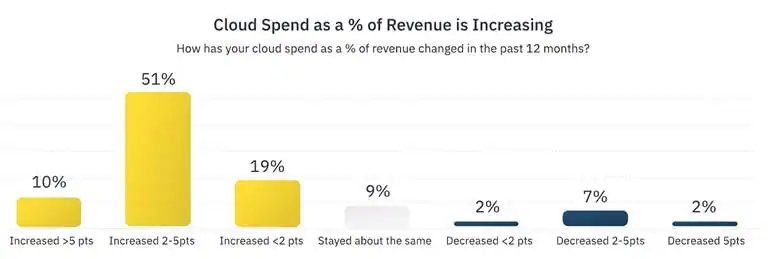
Source: Cloud Capital, The Cost of Compute (2026). Survey of 100 CFOs at growth-stage technology companies.
I recently hosted Ed Barrow, founder and CEO of Cloud Capital, to discuss how finance teams can take control of this expense. My biggest takeaway was simple: CFOs do not need to become cloud engineers. But we do need the data, controls, and operating cadence to translate technical consumption into financial decisions.
AI Cost is More than the Token Bill
When finance leaders think about AI cost, they often start with tokens. That is the most visible new expense, but it is only one layer of the AI cost stack.
An AI-enabled product also requires the infrastructure that moves, processes, stores, and serves data. The company may pay a model provider, but it is also paying for compute, databases, networking, storage, monitoring, and other services surrounding each model interaction. If the chart of accounts captures only the model bill, finance will lose visibility into the AI infrastructure.
And this layer is no longer small. AI and ML workloads already consume 22% of total cloud spend for growth-stage technology companies, and 38% of CFOs say AI is a major contributor at more than 20% of their cloud bill. These workloads also carry real margin risk: companies where AI exceeds 20% of cloud spend are 2.6 times more likely to report margin decline than those with moderate AI exposure.
This requires new general ledger (GL) accounts. At a minimum, finance should distinguish production from non-production spend. Production infrastructure supports live customers and belongs in the cost of goods sold (COGS). Development and testing sit in R&D operating expense. From there, the business can add detail by product, environment, customer segment, provider, or workload where it improves a decision.
The goal is not to build 100 new GL accounts. The goal is to turn a technical invoice into a financial view that explains gross margin by product line and supports forecasting.
CFO Takeaways
- Map the full AI cost stack, not just the model provider invoice. Compute, storage, networking, and monitoring around each model call belong in your AI cost view.
- Split production from non-production as the minimum viable taxonomy. Production goes to COGS. Development and testing go to R&D in OpEx.
- Add GL detail only where it changes a decision: by product, environment, or customer segment. Avoid building 100 accounts nobody monitors.
- Reconcile the token bill against total AI-related infrastructure each month. If model spend grows and surrounding infrastructure does not, you are probably misclassifying costs.
- Treat AI spend as a margin risk item, not just a growth investment. Companies with heavy AI workloads are 2.6x more likely to see margins compress.
The Wrong Forecast Creates the Wrong Commitment
Cloud spend rarely scales in a clean, linear relationship with revenue. A 10% increase in ARR does not necessarily create a 10% increase in compute. A new customer may require heavy processing during onboarding. Usage may expand over the life of the account. A product launch can create a step-change in consumption. An engineering migration may temporarily increase cost because two environments run in parallel before producing savings.
Most finance teams have not solved this yet. Only 26% of CFOs achieve the forecast precision they expect everywhere else: monthly variance of 5% or less. A simple historical trend is only a starting point. A useful infrastructure forecast needs two sets of drivers.
First, connect spend to business activity. This is required for usage-based and outcome-based pricing. Depending on the product, that might be customers, transactions, documents processed, minutes of video, sensors deployed, or another usage measure. The right unit driver helps finance see whether COGS is improving or deteriorating as the company grows.
Second, incorporate the engineering roadmap. Finance may not understand the technical detail behind a server migration, but it must understand the timing and financial impact. What runs in parallel? When does the new architecture go live? What savings should appear, and when? What happens if the project slips by a quarter?
This is where finance and engineering must work together, and the data backs it up. When finance gets involved in cloud cost management, forecast predictability doubles. Joint finance and engineering ownership performs best of all: 39% of jointly owned teams achieve highly predictable forecasts, and 77% report high confidence in cloud COGS accuracy, versus 16% and 42% for engineering-only ownership. Engineering owns the technical assumptions. Finance owns the economic translation, scenario analysis, and forecast discipline. Neither team can build a reliable view alone.
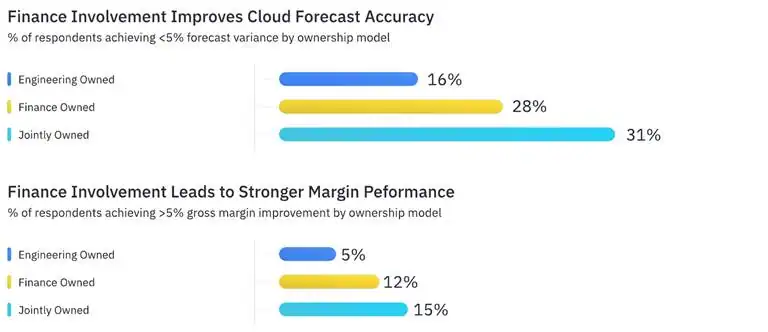
Source: Cloud Capital, The Cost of Compute (2026).
CFO Takeaways
- Pick one usage driver that correlates with spend (transactions, documents processed, minutes of video) and track cost per unit monthly. This is your early warning for COGS deterioration.
- Build the engineering roadmap into the forecast: parallel-run windows, go-live dates, expected savings, and what happens if the project slips a quarter.
- Formalize joint ownership. Finance sets the spending envelope and owns variance explanations. Engineering operates within it and provides technical context.
- Benchmark yourself against 5% monthly variance. That is the precision standard for an expense of this materiality, and only 26% of companies hit it today.
- Do not commit off a trend line. The forecast quality determines commitment quality, which is where the real money is won or lost.
Discounts Are Not the Same as Savings
Cloud providers offer meaningful discounts when customers commit to specific usage for one or more years. Ed explained that discounts can range from about 20% to 60%, and can be even higher for highly specific commitments. Commit to your total spend for one year and you might get 5%. Commit to a specific server type in a specific region for three years and the discount can reach about 72%. Duration and specificity drive the discount.
The catch is obvious once you view it through a CFO lens: the company pays whether it uses the capacity or not. You are locked in.
A commitment is a fixed floor. Usage above the floor remains flexible, but unused committed capacity becomes waste. Greater duration and specificity may create a larger headline discount, but they also increase the risk that a product change, architecture decision, acquisition, customer slowdown, or forecasting miss leaves the company paying for infrastructure it no longer needs.
And the escape hatches are gone. The resale marketplaces and transfer loopholes that once let companies offload unused commitments have been steadily shut down. Cloud providers want locked-in, predictable revenue to back their data center capex, just like we want customers on multi-year agreements.
Therefore, finance should never evaluate a commitment on discount percentage alone. The decision should consider expected utilization, downside exposure, forecast confidence, roadmap flexibility, and who has authority to approve the obligation. Ed noted that these commitments can sit behind the monthly bill without the visibility finance would expect for other multi-year obligations. He has seen companies spending $1 million a year on compute carrying $2 to $3 million in commitments that finance did not know existed, purchased by engineers without authorization. That is a control gap worth closing now.
The right question is not, ‘How large is the discount?’ It is, ‘How much risk are we accepting to earn that discount, and what happens if our assumptions are wrong?’
CFO Takeaways
- Build a commitment register today: every active commitment, its term, expiry, monthly obligation, and current utilization. Many CFOs discover multi-year obligations they never approved.
- Set an approval threshold. Any commitment above it gets CFO sign-off, the same as a lease or any other multi-year obligation.
- Evaluate commitments on downside exposure and utilization confidence, not headline discount. A 60% discount on capacity you abandon is a 100% loss.
- Match duration and specificity to forecast confidence. Commit to your stable base load. Keep spiky, experimental, and AI workloads on flexible pricing.
- Assume no exit. Resale markets and transfer loopholes have closed, so model every commitment as if you will pay it in full.
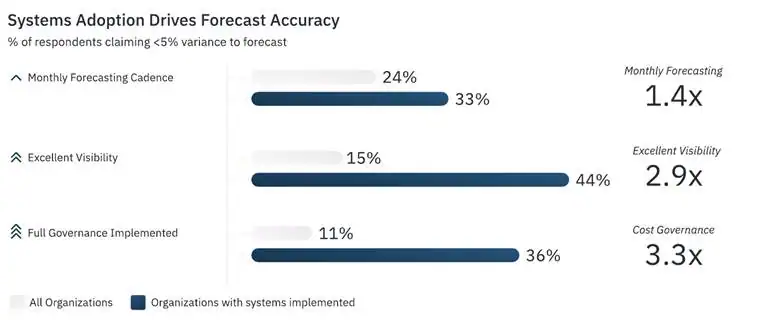
- Governance pays for itself: 35.5% of companies with fully implemented cloud governance achieve highly predictable forecasts, versus 10.5% with partial or none.
Customer-Level Cost Can Change Pricing
For AI-native companies, aggregate gross margin is no longer enough. Two customers paying the same price may create radically different infrastructure costs because of usage volume, model selection, data retention, or workflow complexity.
Once compute can be attributed to an individual customer or use case, finance can provide much better margin analysis. The company may reduce unnecessary data storage, redesign an inefficient workflow, introduce a usage allowance, charge for longer retention, move a feature into a higher-priced package, or reprice an account whose economics no longer work.
The visibility itself is a performance lever. In the research, 43.6% of companies with excellent cost visibility achieve highly predictable forecasts, versus 14.8% of those with good or poor visibility. And precision pays: companies with monthly variance under 5% improve gross margins at 2.8 times the rate of unpredictable forecasters. 69% of them gained more than 2 points of gross margin over the past 12 months, compared to 25% of everyone else.
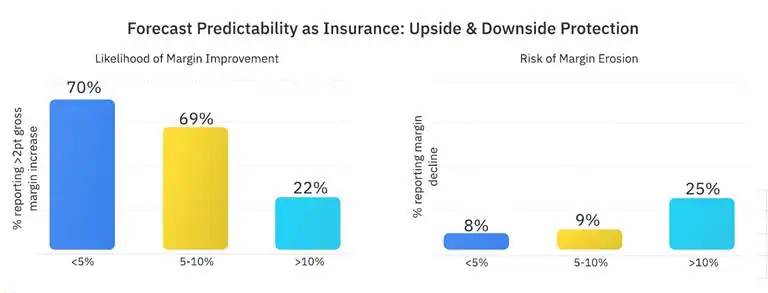
Source: Cloud Capital, The Cost of Compute (2026).
This is not merely cost cutting. It is product and pricing intelligence. Customer-level cost data helps the company protect margin without blindly reducing infrastructure investment that customers value.
CFO Takeaways
- Instrument cost attribution by customer, product, and workload through tagging discipline. You cannot price what you cannot attribute.
- Rank customers by gross margin, not just revenue. Flag accounts where compute cost per dollar of revenue is deteriorating.
- Turn cost data into pricing action: usage allowances, retention tiers, feature repackaging, and repricing accounts whose economics no longer work.
- For usage-based or outcome-based pricing, customer-level unit cost is a prerequisite, not a nice-to-have.
- Do not default to broad cost cuts. Attribution lets you separate strategic investment from operational waste.
A Practical Operating Cadence for CFO’s
If cloud infrastructure is material, I would add it to the monthly finance and engineering review. Start with five questions:
- What did we spend, and why did it change?
- What belongs in production COGS versus operating expense?
- Which business and technical drivers explain the variance?
- How has cost per customer or other relevant usage unit changed?
- What roadmap changes or commitments could alter the next 12 months?
Monthly matters. In the research, 33.3% of monthly forecasters achieve highly predictable outcomes, and none report variance above 10%. Monthly forecasters are also 1.5 times more likely to improve margins than teams forecasting quarterly or less. Quarterly cadence works for stable expenses. Cloud is not one.
The most predictable companies run three systems together: visibility that shows what drives cost, governance that prevents costs from deviating, and a monthly cadence that catches variance before it compounds. Only 11.5% of companies have implemented all three, but those that have dominate the ranks of the most predictable forecasters.
Source: Cloud Capital, The Cost of Compute (2026).
The first month may be messy. That is fine. Establish the taxonomy, assign owners, document the assumptions, and improve the model each cycle. The objective is not false precision. It is enough visibility to detect margin pressure early, challenge a poor commitment, and connect infrastructure decisions to the operating plan.
The urgency is only increasing. 73% of CFOs expect cloud spend as a percentage of revenue to rise over the next 12 months, and the top cloud priorities for 2026 read like a finance agenda: improving gross margin (44%), increasing forecast accuracy (44%), and reducing waste (44%). Variance on a growing base does not stay flat. It accelerates.
We already apply strong controls to payroll, travel, and SaaS applications. Cloud infrastructure deserves the same treatment. It is too large, too volatile, and too closely tied to AI unit economics to remain buried inside a technical invoice.
Finance does not need to take infrastructure away from engineering. It needs to create a shared financial language around it. That is how the CFO protects gross margin while giving engineering room to build.
Download Cloud Capital’s full report here.
CFO Takeaways
- Add cloud to the monthly close review with the five questions above. Assign a named owner in finance and a named counterpart in engineering.
- Move to a monthly reforecast cadence for cloud even if the rest of the model runs quarterly. It is the single discipline that eliminates 10%+ variance.
- Stand up all three systems: cost visibility, spend governance, and monthly cadence. Only 11.5% of companies run all three, which makes it a genuine competitive edge.
- Track cost per usage unit as a standing KPI alongside gross margin. It tells you whether unit economics improve or deteriorate as you scale.
- Plan for cloud to take a bigger share of revenue in 2026. Build the controls now, before the base grows and the variance compounds.

I have worked in finance and accounting for 25+ years. I’ve been a SaaS CFO for 9+ years and began my career in the FP&A function. I hold an active Tennessee CPA license and earned my undergraduate degree from the University of Colorado at Boulder and MBA from the University of Iowa. I offer coaching, fractional CFO services, and SaaS finance courses.