
When I build forecasts and budgets for founders and executive teams, it’s easy to treat a revenue or bookings miss like normal budget variance:
“We missed our ARR target by 10% this year. That stings, but if we execute our plan and grow 50% next year, we’ll be back on track.”
It sounds reasonable. In a transactional or professional services business, it is. An annual shortfall resets when the calendar flips. Each year starts at zero under age-old budget philosophies, and next year’s revenue depends on next year’s sales pipeline.
SaaS is different. Recurring revenue stacks on top of itself. Next year’s ARR is built on this year’s ending ARR. A smaller base means fewer dollars from the same growth rate.
Hitting your growth rate does not erase a miss. It carries the miss forward, and the miss gets bigger in dollars.
Let’s dive into the SaaS math reality of ARR misses. Calculator below for download.
The base effect: percentage parity vs. dollar parity
In a recurring revenue model, ending ARR is the launchpad for all future net new ARR. When that base ARR shrinks, every percentage increase generates fewer absolute dollars on top of that smaller base.
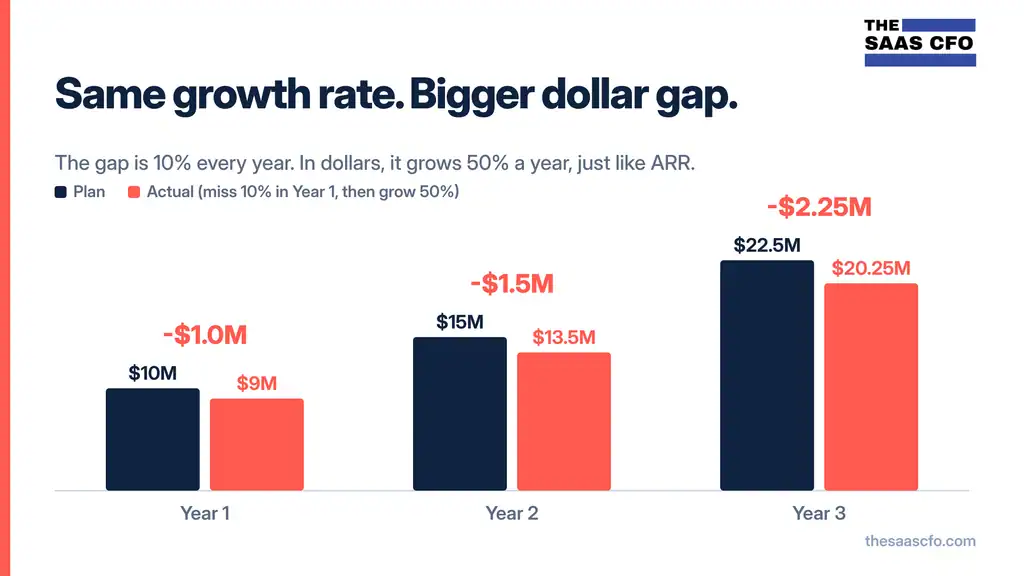
A company ends Year 0 at $5M ARR. The plan is $10M in Year 1, then 50% growth each year after. Now, let’s say the company finishes Year 1 at $9M, a $1M (10%) miss. The team then executes cleanly and grows exactly 50% in Years 2 and 3.
| Year | Plan ARR | Actual ARR | Dollar gap | % gap |
| Year 1 | $10.0M | $9.0M | -$1.0M | 10% |
| Year 2 (+50%) | $15.0M | $13.5M | -$1.5M | 10% |
| Year 3 (+50%) | $22.5M | $20.25M | -$2.25M | 10% |
Look at the last two columns. The percentage gap never moves. It stays at 10%. But the dollar gap grows from $1.0M to $1.5M to $2.25M. The gap grows at 50% a year, exactly like ARR does.
That’s a big deal if you’re valued at 5X ARR. That’s $11.3M of lost valuation dollars on lower ARR volume. Not pocket change.
Net new ARR tells the same story. In Year 3 the plan called for $7.5M of net new ARR. The company delivers $6.75M, even though it hits its 50% growth rate.
Matching your target growth percentage does not restore the plan. It permanently bakes in the shortfall. That’s the big takeaway.
Three forces behind the widening gap
The table above is the clean version. In a real operating model, three forces drive the ARR shortfall. The first is already baked inside the table. The other two show up in your cash and your capacity.
1. Net Revenue Retention (NRR) Drag
SaaS financial models rely on existing ARR expanding organically and through GTM influence. If your business runs at 110% net revenue retention, that $1.0M missing base in Year 1 does not just represent lost contract value today. It removes $100,000 of expansion ARR in Year 2 and $110,000 in Year 3. You don’t have as much ARR and as many customers to expand.
One note for your model. Expansion is one of the pieces of the 50% growth rate in the table, so these dollars are already considered inside the $1.5M and $2.25M gaps. They explain why the gap grows. They are not an extra hit on top of it, so do not count them twice. The point is, we grow the new ARR and expansion ARR.
2. Headcount and Expense Misalignment
Operating expenses are typically committed 3 to 12 months ahead of revenue realization. Sales reps are hired, quota capacity is allocated, and tooling is purchased based on the budgeted trajectory.
When ending ARR comes in 10% light:
- CAC payback periods lengthen: Sales and marketing expenses were sized to support higher additions.
- Gross margins compress: Support, hosting, onboarding, and customer success infrastructure were provisioned for higher scale. But, hopefully, the marginal impact should be less.
- Cash runway shortens: Unplanned burn or lower cash balances force either emergency expense rationalization or dilutive capital raises.
3. The Capacity Deficit (The Catch-Up Trap)
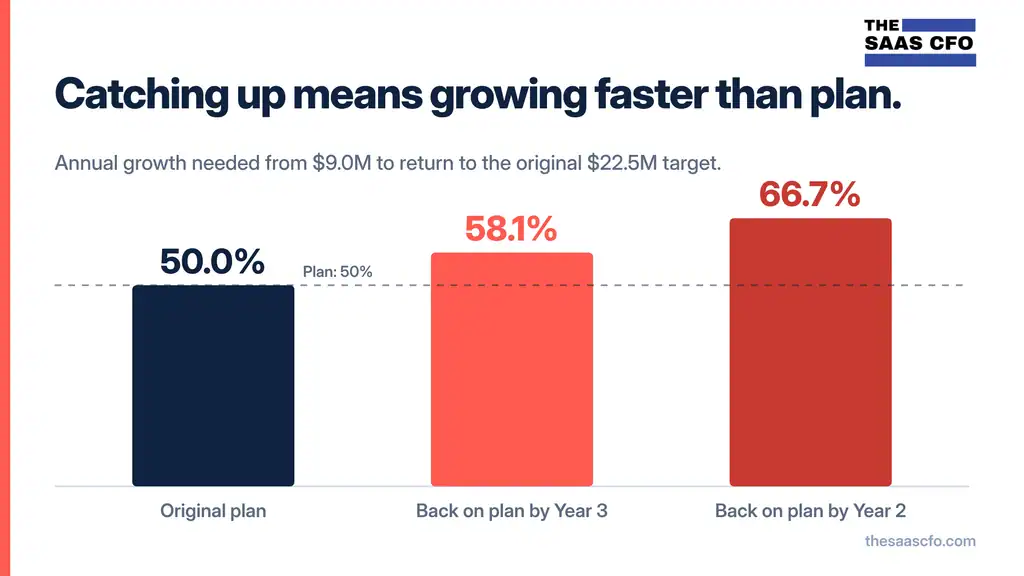
To close the dollar gap and return to the original Year 3 target of $22.5M ARR from a $9.0M baseline, growing at 50% is no longer enough. The company must compound at 58.1% annually:
Required growth = (22.5 / 9.0) ^ (1/2) – 1 = 58.1%
That 8.1 percentage-point delta means net new ARR of about $5.2M in Year 2 and $8.3M in Year 3. The original plan called for $5.0M and $7.5M. Delivering it requires ramping extra sales capacity, accelerating pipeline generation, and/or improving conversion rates, all while managing the tighter cash constraints caused by the initial miss. And extra Board and investor scrutiny.
And that is the two-year path. To be whole in just one year, the company would need to grow 66.7%. That could be a tough forecast for your CFO to believe.
How to present this to your board and leadership team
When walking executives and board members through an ARR variance, use this framing to keep strategy grounded in reality:
- Separate dollar parity from growth rate parity. Be explicit that “hitting next year’s growth target” from a reduced base still leaves the company further behind in enterprise value and cash generation.
- Re-anchor long-range milestones. Do not leave downstream ARR targets untouched if current-year additions are missed. If Year 1 drops by $1M, either adjust Year 2 and Year 3 targets down or present an explicit, costed plan detailing where the extra pipeline capacity will originate.
- Protect the CAC payback ceiling. Resist the temptation to make up the dollar gap overnight by pouring inefficient capital into paid acquisition. Chasing an unadjusted top-line target with declining unit economics compounds cash burn faster than the revenue deficit itself.
Quick checklist for finance teams
- Run the multi-year baseline miss. Recalculate your 3-year ARR model with a 5%, 10%, and 15% miss against current-year ending ARR, holding future growth rates constant.
- Quantify the NRR downstream loss. Isolate the expansion dollars lost from the missing cohort base over a 24-month horizon.
- Audit quota capacity vs. catch-up targets. Compare the net new ARR per ramped AE required under an unadjusted board plan against historical rep productivity.
- Recalibrate hiring triggers. Tie go-to-market hiring approvals to booked ARR milestones, not calendar dates.
The bottom line
An ARR miss is not a one-year event. It is a permanent change to your base ARR. Make sure this is acknowledged if you are executing against a 3-year plan.
For bootstrapped founders without PE or board pressure, this should still create urgency. I work a lot of founders who want to exit in 1 to 3 years. If the GTM machine is not working and there is no focus on it, you are leaving dollars on the table that could have been compounding in your favor.
Time moves fast. In three years, you’ll thank today’s version of yourself for making the necessary changes.
Download the template below for your scenario planning.

I have worked in finance and accounting for 25+ years. I’ve been a SaaS CFO for 9+ years and began my career in the FP&A function. I hold an active Tennessee CPA license and earned my undergraduate degree from the University of Colorado at Boulder and MBA from the University of Iowa. I offer coaching, fractional CFO services, and SaaS finance courses.